
Evacuation Day and the Aftermath of the Siege of Boston
Evacuation Day, March 17, is such a local holiday that if you live outside of the Boston area, you may have never heard of it, though some other cities, such as New York, also have their own Evacuation Days. Boston’s version of the holiday celebrates the day when the British army “evacuated” Boston during the American Revolution – that is to say, the day when revolutionary forces in Massachusetts finally seized control of the colony’s capital, ending a nearly year-long siege.
Evacuation Day didn’t become a legal holiday in Massachusetts until in 1941. However, March 17, which also happens to be Saint Patrick’s Day, has been historically celebrated by Boston’s large Irish Catholic population since the 19th Century. The origins of Evacuation Day as a legal holiday may have more to do with that coincidence than the date’s historical interest: celebrating the evacuation provided a secular excuse to take the day off from work.[1] In fact, Governor Leverett Saltonstall signed the law creating Evacuation Day with green ink, a joke proposed by Irish-American Senator Joseph L. Murphy who had sent it to him along with a note which read “I believe it is quite appropriate to use the favorite color of our mutual ancestry.”[2] But civic shenanigans aside, March 17, 2026 is a particularly interesting Evacuation Day, because it marks the 250th anniversary of the end of the siege of Boston – likely a very emotional time for Paul Revere and his family.
When the Patriots rebelled against British rule at the start of the Revolutionary War, rebel forces did not seize control of all of Massachusetts at once. Paul Revere is now famous for his role in the beginning of that uprising on April 18, when he warned Patriots in Lexington about the British army’s advance to seize the Concord powderhouse. When Patriot forces in Lexington refused to let the British army pass, the first battle of the American Revolution broke out, not in Boston, but in the countryside. By the end of that day, Patriot forces had chased the redcoats out of Lexington, Concord, Medford, Cambridge, Charlestown, and Watertown. But the British army still managed to hold the peninsula of Boston, which was Massachusetts’s center of colonial government, as well as one of the colony’s major port cities. Surrounded and severely outnumbered by rebel forces, the commander of British forces, General Gage, would have been mainly concerned with fortifying the city and making a plan to safely evacuate the loyalists. Meanwhile, the Patriots, lacking sufficient artillery to launch an all-out attack on Boston, instead began a siege, attempting to starve out the Regulars by cutting off the flow of firewood and food to the city.
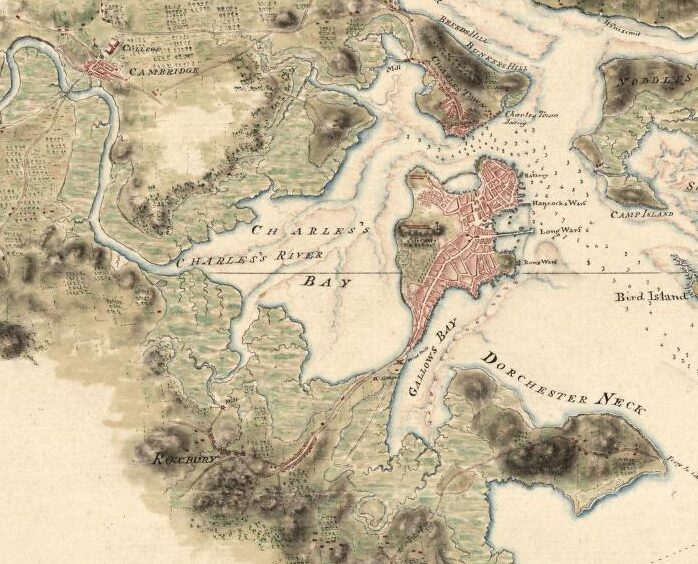
The Siege of Boston went on for nearly 11 months. During this time, civilians in Boston had to make a difficult choice as their home rapidly became a warzone: whether to “retire from the Town and leave their All behind” or to “stay and take Care of their Substance.”[3] Leaving the city was difficult – citizens had to secure permission from British officials to leave, and were subject to ever-changing rules about what they were allowed to take with them: often only their bedding and the clothes on their backs. Still, many Patriot families who feared violence and persecution by the British army fled to the Patriot-controlled side of the Charles River. “You’ll see parents that are lucky enough to procure papers, with bundles in one hand and a string of children in the other, wandering out of the town (with only a sufferance of one day’s permission) not knowing whither they’ll go,” John Andrews observed that April.[4] Revere’s family, for instance, likely bribed a British officer to secure a pass granting them permission to leave the city. They moved to Watertown, about 8 miles outside of Boston.[5]
However, many civilians, fearing for the future of their homes and property, decided to stay. Abandoned buildings might become easy targets for robbery or even scrapped for firewood if fuel got scarce. Merchants who owned cargo in the port’s warehouses didn’t want to leave their investments to be looted. The merchant John Andrews wrote “the absolute refusal of the Governor to suffer any merchandize to be carried out of the town, has determin’d me to stay and take care of my effects.”[6] Even Revere’s 15-year-old son, Paul Jr., may have stayed behind to keep an eye on the family’s home. Those who remained lived in a town half-deserted: “a Solemn dead silence reigns in the Streets [where] numbers have packed up their effects, & quitted the Town.”[7]
The Siege of Boston went on for nearly a year. As Andrew Eliot put it poetically in a letter to his son on April 23rd of 1775, “This town a garrison; every face gathering paleness.”[8] Inhabitants of the town lived under martial law with strict curfews. The British army, concerned about spies and rebels within their midst, restricted the movements of inhabitants of the town after 10 pm, and opened and censored mail going in and out of the city. Civilians in Boston lived in fear that they could be beaten, jailed, or have their property seized if they were suspected of Patriot sympathies.[9]
As the siege dragged on, supplies in Boston became even harder to come by. As early as April 30th, a British soldier reported that “There is no market in Boston, the inhabitants all starving; [and] the soldiers live on salt provisions.”[10] John Andrews complained on June 1st about steeply rising prices for essential goods: “we have now and then a carcase offer’d for sale in the market, which formerly we would not have pick’d up in the street; but bad as it is, it readily sells for eight pence Lawful money per lb…wood not scarcely to be got at twenty two shillings a cord.”[11] While the army was resupplied by sea, they were forbidden to resell their food and fuel, so civilians took the brunt of the resource crisis. Andrews wrote later on that “many were the instances of the inhabitants being confin’d to the Provost for purchasing fuel of soldiers, when no other means offer’d to keep them from perishing with cold – Yet such was the inhumanity of our masters, that they were even deny’d the privilege of buying the surplusage of the soldier’s rations.”[12]
As the fall turned to winter, the firewood shortage became particularly dire. Timothy Newell, a Patriot living in Boston, recorded in October that “Houses, fence, trees &c. pulled down and carried off for fuel,” and in January “The Old North Meeting House, pulled down by order of General Howe for fuel for Refugees and Tories.”[13] While British officials tried to regulate the seizing of property to be burned for firewood, they could not prevent cold and desperate soldiers from busting up houses and stealing shutters, siding, or furniture to burn. Starvation conditions and a shortage of firewood also made residents of Boston more susceptible to disease, and likely exacerbated outbreaks of smallpox in the city which claimed many lives during the siege.[14]
Though the Patriots had hoped to force the British out of Boston by cutting off access to supplies, a blockade alone was not enough to make the army to abandon the city. But in March of 1776, the Patriots finally gained access to artillery. Patriot forces had managed to seize cannons from the British Fort Ticonderoga and transport them back to Boston under command of Henry Knox. On March 5, the sixth anniversary of the Boston Massacre, Patriots positioned cannons on Dorchester Heights, where they could level them at the city across the harbor. Over the course of the next few days, Patriot leaders including General George Washington negotiated the terms of the British army’s departure.[15] General Howe, Gage’s successor, agreed to order his troops to evacuate the city without razing it, if the Patriots agreed not to fire on them. On March 6th, Timothy Newell wrote “orders [are] being given to embark the King’s Troops and evacuate the town. Blessed by God our redemption draws nigh.”[16] On March 17th, 8,906 soldiers and 1,100 loyalist civilians left Boston – many of them never to return.[17]
For Patriot refugees, returning to Boston would be a slow process. British troops first removed just to Castle Island, and many Patriots may have worried that they were not yet gone for good. Even when the city seemed safe to come back to, refugees like Revere’s family would have returned in April and May to a nearly abandoned city which hardly resembled the one they had left; entire churches and houses had been pulled down and burned for firewood during the siege, and many loyalist neighbors had fled for Canada or other safer parts of the British empire. Despite the British army’s orders to leave the town unharmed, George Washington reported in late March, “the inhabitants have suffered a good deal by being plundered by the soldiery at their departure.”[18] The merchant John Rowe had his warehouses ransacked three times in the week between March 6th and 12th and had lost a “Value of twenty two hundred and sixty pounds sterling….in Linens, Chekcs, Cloths & Woolens” at the hands of marauding soldiers.[19] Returning to Boston in late March, Ezekiel Price wrote “As I passed through the town, it gave me much pain of mind to see the havoc, waste and destruction of the houses, fences, and trees in the town, occasioned by those sons of Belial, who have, near a year past, had the possession of it,” and “The town appears in many places but little better than a heap of ruins.”[20]
Still, even with the agony of having lost homes, friends, and neighbors, and uncertainty about what the war-torn future of America held, the worst danger of the siege had passed. The evacuation of Boston was a hopeful time for many residents who were able to return home. Families separated by the siege were finally reunited. It may have been the first time Paul and Rachel had seen their teenage son, and Paul’s sister and elderly mother, in nearly a year. And, for the first time in the eight years since troops had first arrived to suppress the protests in 1768, the British army was gone. Bostonians could finally breathe freely, in a city no longer under military occupation by the Regulars. We see this tentative yet hopeful mood in a diary entry from Ezekiel Price, dated March 29: “…went to Boston, where a town-meeting was held…the scattered inhabitants collected together, met at the Old Brick Meeting-house…and it was really a very pleasant sight, after near eleven month’s absence, to see so many of my worthy fellow-citizens meet together in that now ravaged, plundered town.”[21] Rebuilding while war continued to tear through the thirteen colonies would be a slow process, but at least it could begin.
Mehitabel Glenhaber is a Program Assistant at the Paul Revere House. This blog post is adapted from research done by Jayne Triber in 1999 for the museum’s “Bringing History Home” project.
[1] https://www.wbur.org/news/2010/03/12/evacuation-day-holiday
[2] https://www.wbur.org/news/2025/03/14/evacuation-day-history-boston-massachusetts-revolutionary-war-newsletter
[3] Boyle’s Journal of Occurrences in Boston, 1759-1778, New England Historical and Genealogical Register, 85 (Jan, 1931), p. 12-13.
[4] “Letters of John Andrews,” MHS Proceedings 8 (July 1865), pp. 405-406.
[5] Jayne Triber, A True Republican, (University of Massachusetts, Amherst, 1998), p. 115.
[6] “Letters of John Andrews,” pp. 405.
[7] Laura Rocklyn, “Windows into Daily Life During the British Occupation of Boston,” The Revere Express, May 8th, 2020. https://www.paulreverehouse.org/windows-into-daily-life-during-the-british-occupation-of-boston/#_ftn7.
[8] “Letter from Reverend Dr. Andrew Eliot to his son Andrew,” MHS Proceedings 16 (July 1878), pp. 182-83.
[9] Jayne Triber, Historical Background on the Siege of Boston and Adolescence in the Revolutionary Period for “Bringing History Home” Project, Paul Revere Memorial Association, 1999, pp. 32-33.
[10] Peter Force, ed., American Archives, 4th series (Washington DC, 1837-53), vol. II, p. 441.
[11] “Letters from John Andrews,” p. 408.
[12] “Letters from John Andrews,” p. 410-411.
[13] “A Journal Kept During The Time Yt Boston Was Shut Up in 1775-1776, by Timothy Newell, Esq.,” MHS Collections, 4th ser…I (1852), pp. 268-71. The word “Tories” refers to loyalists, or supporters of the British government.
[14] Triber, Historical Background on the Siege of Boston.
[15] Triber, Historical Background on the Siege of Boston, p. 56-57.
[16] “Timothy Newell’s Diary,”pp. 271-276
[17] https://www.wbur.org/news/2025/03/14/evacuation-day-history-boston-massachusetts-revolutionary-war-newsletter
[18] Force, American Archives, 4th ser., vol. IV, p. 560.
[19] Cunningham, Anne Rowe, ed., Letters and Diary of John Rowe, (Arno Press: 1969), pp. 300-304.
[20] “Diary of Ezekiel Price, 1775-1776,” MHS Proceedings 7 (November 1863), 244-252.
[21] “Diary of Ezekiel Price, 1775-1776,” MHS Proceedings 7 (November 1863), 244-252.