
Paul Revere and The American Chorister
By: Mehitabel Glenhaber
While Paul Revere is best known as a silversmith, he also created copperplate engravings. Engraving was a way for Revere to secure a second source of income during the economically tumultuous years leading up to the American Revolution, but it was also a way for him to exercise his political voice. In 1770, six months after he created his famous Boston Massacre engraving, Revere made a set of plates for the frontispiece and likely also the pages of sheet music for The New England Psalm Singer, or The American Chorister which the Paul Revere House has a copy of in our museum collection. This collection of music was composed by William Billings (1746-1800), a member of the Sons of Liberty who would go on to become one of the prominent composers of the American Revolution.[1] The New England Psalm Singer was one of the first books ever published to contain choral music composed entirely in America – and one of the first to identify itself as an “American” psalm book.[2] When it came out, It nearly tripled the number of published American choral compositions.[3] The New England Psalm Singer presents a fascinating look into the state of both choral music and politics in Boston just before the start of the Revolutionary War, and how Patriots used music to create an American identity independent from England.
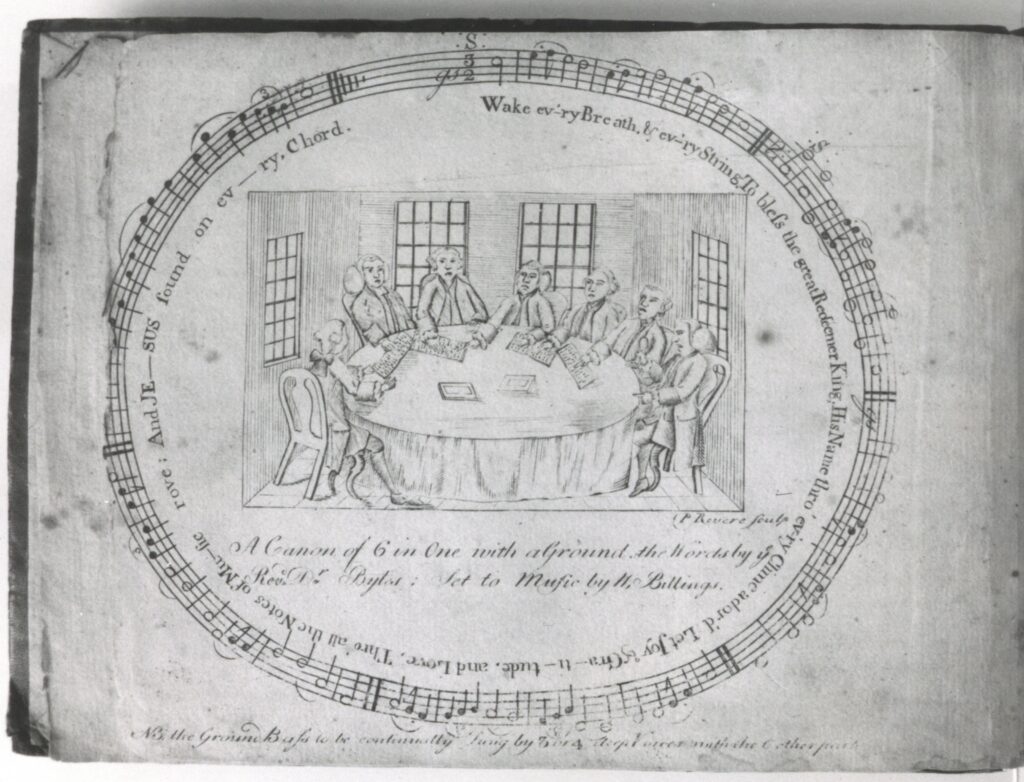
Music was a deeply political and religious practice in colonial New England. In the 1600s, one of the major schisms between the Puritans who colonized Massachusetts and the Anglican church back in England was over psalm singing. The Puritans prohibited the use of instruments and church organs in worship, which they believed were unnecessary “ornaments,” and too close to Catholic musical traditions.[4] The strictest Puritans even opposed singing in parts, singing lessons, or anything which would create divisions of musical skill and authority between members of the congregation.[5] However, in the 1700s, formal singing schools and more complex tunes began to become popular in New England. Newly imported British psalm books with new tools for teaching music proliferated in America in the 1720s,[6] and congregants got more excited about these new compositions and technique. Congregationalist ministers, tired of the difficulties of leading psalms for a church full of untrained singers, also gradually warmed to singing schools. In the late 18th Century, over one hundred new psalm books were published in America, including new compositions by American composers,[7] and collections of British psalm tunes, like Josiah Flagg’s Collection of the Best Psalm Tunes (1764) (which Paul Revere also engraved).[8] Many young people attended singing schools, where they learned to read music, refine their vocal technique, and sing in parts. In churches, it became more common for congregations to sit together by vocal part.[9] As the frontpiece of The New England Psalm Singer shows, choral singing in both religious and secular contexts became an enormous part of social life in New England during Revere’s lifetime. Like the friends depicted in Revere’s illustration, New Englanders would often meet up in their homes to practice for church choirs, rehearse for more secular musical performances called “singing lectures,” or to simply sing religious, political, or humorous songs together for fun.[10] To support this new interest in skilled choral music, “composer” and “singing instructor” became, for the first time, careers which a resident of New England could pursue.
William Billings (1746-1800) was one of America’s first and most prolific choral composers, and the founder of one of Boston’s first singing schools in 1769.[11] Like Paul Revere, he was a middle class artisan who worked a variety of trades and odd jobs as the primary provider for his family, after his father died at a young age.[12] He likely never had any formal training in singing outside of singing in the congregation of the New South Church and Old South Meeting House.[13] His main source of income was his work as a tanner.[14] Like many singing instructors, Billings supplemented his income by composing music and publishing psalm books (mainly settings of hymns by the British poet Isaac Watts).[15] Over the course of his life, he published six books (some simple tunes for beginners and some for more advanced singers) and composed over three hundred songs, far exceeding the body of work of any other American composer at the time.[16] Most of his books contained both choral compositions and essays on music theory, and occasionally, guidelines for aspiring singing instructors to establish their own schools.[17] While Billings’ tunes were grounded in the tradition and style of New England psalm singing and generally written to be accessible to newer singers, they also introduced more complex harmonies.[18] Billings’ music was highly influential in the development of choral music in America – one of his obituaries referred to him as “the father of New England music ”[19] and his songbooks were widely reprinted. Billings himself never attained much financial success, and died in relative poverty.[20] However, many of his songs remain popular in the Sacred Harp canon, a popular American Protestant hymnal, and his music is generally regarded as an example of the best of 18th century New England choral composition.
Also like Revere, William Billings was an energetic Patriot and member of the Sons of Liberty. Billings saw music as a radically egalitarian tool, which, in the spirit of the American Revolution, leveled common people and nobility. “Here [in choral singing] the king and the peasant, the prince and the porter are in unison with each other. Here are pleasures ecstatic, and joys never fading,” he wrote in The Singing Master’s Assistant in 1778.[21] Billings also used his artistic abilities to create propaganda for the Patriot cause. While the majority of Billings’ tunes were psalms, he also composed songs in support of American independence. Billings’ songs became a rallying cry to many Patriots during the American Revolution, as both a political statement against British dominion over America, and a celebration of the American choral tradition as a part of an American identity separate from England.
Billings’s first book, The New England Psalm Singer, first went to print just six months after the Boston Massacre, at a point when tensions between Patriots and Loyalists in Boston were reaching a new high. The book was a perhaps unexpected collaboration between figures across the political spectrum. It was illustrated by Paul Revere, who was already printing criticism of the British government. It also contained contributions from Dr. Mather Byles, the Loyalist rector of Old North Church. The book was published and distributed by Benjamin Edes and John Gill, the distributors of a prominent Patriot newspaper, and Josiah Flagg, a close acquaintance of Revere’s.
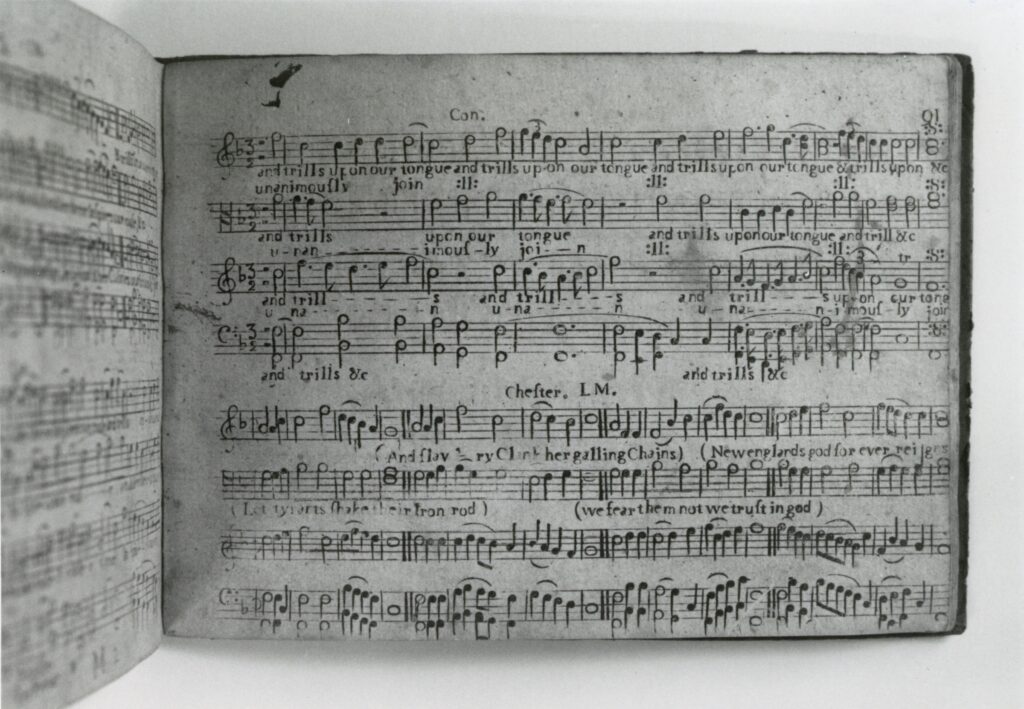
Responding to a tense political moment, and perhaps balancing its collaborators’ varied political opinions, the text of The New England Psalm Singer opens with a call for Patriots and Loyalists to set aside their differences. The lyrics to one of the songs, Europe, quoted on the frontispiece of the book, reads:
“Let Whig and Tory all subside
And politicks be dumb;
A nobler theme inspires our Muse,
and trills upon our Tongues.
O praise the Lord with one Consent
And in this grand Design
Let Britain and her Colonies
Unanimously join.”
Perhaps as an olive branch to some of the book’s more centrist contributors and funders, this song promotes an almost utopian idea that through a shared love of music and God, Whigs (Patriots) and Tories (Loyalists) would be able to overcome their differences and live in harmony.
However, in other places, The New England Psalm Singer espouses fiery Patriot sentiments. On the page following Europe, the next psalm, Chester, reads:
“Let Tyrants shake their iron Rod,
And Slav’ry clank her galling Chains;
We fear them not, we trust in God,
New England’s God forever reigns.”
It would have been obvious to any New Englander paying attention to the contemporary political discourse that the “Tyrants” this song was referring to were Massachusetts’ royal governor and England’s parliament. Even religion, which was presented as a peacemaking shared value in Europe, became a politicized force in Chester – “New England’s God” is presented as a partisan figure who sides only with the colonies.
The introduction to The New England Psalm Singer is also full of pro-independence sentiments. In the introduction, Billings emphasized that “The Author [has] deferred the Publication of these Sheets for Eighteen Months, to have them put upon American Paper” so that the publication of the book could be compliant with Sons of Liberty boycotts against imported British goods taxed by the Stamp Act.[22] Billings also further encouraged readers to participate in these boycotts, writing that he hoped “the good Ladies, Heads of the Families, into whose Hands they may fall, will zealously endeavor to furnish the Paper Mills with all the Fragments of Linnen they can possibly afford[sic].”
Even the legal circumstances of The New England Psalm Singer’s printing ended up being colored by tensions between Patriots and Loyalists in Boston. In 1772, Billings applied for copyright to his book, which was approved by members of the Massachusetts Congress, including Samuel Adams, but denied by Governor Bernard. Bernard may have refused to sign it because of Billings’ Patriot sympathies and alliances. Billings was not able to secure legal copyright to the book until 1780, when the American Revolution was nearing its conclusion.[23]
Nevertheless, The New England Psalm Singer captured a moment in the fall of 1770 where, however high political tensions were running in Boston, a Patriot and Loyalist could still come together through shared music and religion to collaborate on a psalm book. By 1780, the time of the book’s second printing, that was no longer the case. Dr. Mather Byles had been ousted by his congregation, and had been banished from Boston on pain of death by the new Patriot administration.[24] In the second printing of the New England Psalm Singer, Edes and Gill had struck Byles’s name from the frontpiece and title page.[25] Billing’s next printing of Chester added several more verses, including one which read:[26]
“Howe and Burgoyne and Clinton too,
With Prescot and Cornwallis join’d,[27]
Together plot our Overthrow,
In one Infernal league combin’d.
…
The Foe comes on with haughty Stride;
Our troops advance with martial noise,
Their Vet’rans flee before our Youth,
And Gen’rals yield to beardless Boys.”
Billings was no longer needed to play coy about who the “Tyrants” were, and was openly celebrating armed resistance against the British army.
The New England Psalm Singer provides a useful look into the role that artists and artisans like Revere and Billings played in the Patriot movement. Even before the war broke out, Billings advocated for the power of music to create an American identity independent of the British empire – songbooks of American compositions, printed on American paper. Billings understood that music could both build bridges and divide people. His compositions drew on the New England choral singing tradition to build social ties between American colonists in churches, parlors, and singing schools, and at the same time encouraged Americans to sever their ties to the British empire
Mehitabel Glenhaber is a Program Assistant at the Paul Revere House.
[1] Clarence S. Brigham, Paul Revere’s Engravings, (American Antiquarian Society, 1969), 86-92.
[2] Joshua Cohen, “Musical Life in Colonial and Early Federal America: 1620-1820,” Revere House Gazette Summer 1987, 2.
[3] Elizabeth B. Crist, “”Ye Sons of Harmony”: Politics, Masculinity, and the Music of William Billings in Revolutionary Boston,” The William and Mary Quarterly, Apr., 2003, Vol. 60, No. pp. 333-354., 334.
[4] Alan Clark Buechner, Yankee Singing Schools and the Golden Age of Choral Music in New England, 1760-1800, (Boston University Dublin Seminar for New England Folk Life, 2003), 3.
[5] Buechner, 4.
[6] Sondra Wieland Howe, “The Tune Books of William Billings: Music Education in the Eighteenth Century,” The Bulletin of Historical Research in Music Education, Sep., 1998, Vol. 20, No. 1 (Sep., 1998), pp. 43-55, 44 and Buechner, 19.
[7] Mary Gosselink De Jong, “”Both Pleasure and Profit”: William Billings and the Uses of Music,” The William and Mary Quarterly, Jan., 1985, Vol. 42, No. 1 (Jan., 1985), pp. 104-116, 109.
[8] https://collections.americanantiquarian.org/revere/music.htm
[9] Buechner, 91
[10] Cohen, 2-3
[11] Crist, 334.
[12] Mark Fonder, “William Billings: A Patriot’s Life?,” The Bulletin of Historical Research in Music Education, Sep., 1997, Vol. 19, No. 1 (Sep., 1997), pp. 1-9, 2.
[13] Rose Dwiggins Daniels, “William Billings: Teacher, Innovator, Patriot,” Music Educators Journal, May, 1988, Vol. 74, No. 9, pp. 22-25, 23.
[14] Fonder, 1.
[15] Buechner, 48-50.
[16] Crist, 333 and Daniels, 24.
[17] Buechner, 65 and William Billings, The Singing Master’s Assistant, (Edes and Gill, 1778).
[18] Joshua Armenta, “Colonial Nationalism in the Music of William Billings,” The Choral Journal, OCTOBER 2011, Vol. 52, No. 3, pp. 6-14, 9 and De Jong, 115.
[19] De Jong, 104.
[20] De Jong, 115 and Fonder, 9.
[21] Kroeger, 1.
[22] Brigham, 87.
[23] Crist, 336-337.
[24] https://www.oldnorth.com/blog/this-old-pew-6-rev-mather-byles-jr/
[25] Buechner, viii.
[26] Buechner, 103.
[27] This verse references the names of several British generals.