
What’s For Dinner?
By: Katie Burke
During the holiday season, food is often on everyone’s minds. Menus are prepared, ingredients are purchased, and baking is done. But what was cooking like in colonial times? Cooking, and eating, were quite different during Revere’s time than today. For one, the Reveres lived in a time before electricity-powered refrigeration, so there were only a few means for keeping food cold. Food could be stored in the basement or cellar underground to keep it at a somewhat constant (cool) temperature, but it still needed to be carefully packed to prevent mold. But even before food could be preserved or stored, it had to come from somewhere.
Although Boston in the 1770s was part of a global economy, and enjoyed trade all over the world, there were still some products which were only available during certain seasons or were more plentiful at certain times. For example, fresh strawberries, blueberries, and huckleberries would be plentiful in the summer months but only available as preserves during the winter and spring. Likewise, apples, pears, and peaches ripen in the fall, so pies could be made with fresh fruit in the fall and early winter, but if you wanted an apple pie in March, you’d be using dried apple slices. Drying fruit slices over the hearth was quite common. If you visit the Revere House kitchen, you’ll see real dried fruit slices and herbs hanging around the hearth, along with replica food items and real antique furniture and cooking tools. Dried fruit can be stored for many months without molding, so fresh fruit would either be dried or turned into “sweetmeats”, similar to today’s jam. Sweetmeats could be made at home or purchased, and could last for a few months before mold set in. Once that happened, it was necessary to skim off the mold and boil the sweetmeats again.[1] Living in an urban environment with plentiful trade routes, the Reveres would have enjoyed longer seasons for many of their ingredients, but there would still be some seasonal changes to meals.
One way to get a sense of what ingredients were available is to look at shop advertisements in newspapers. Foods readily available at the market included cheese, pepper, nutmeg, cinnamon, cloves, mace, flour, pork, corn, wheat, oats, meat, poultry, fish, butter, molasses, tea, coffee, chocolate, vinegar, rice, and alcohol.[2] So a wide variety of ingredients and flavorings would be available to a family such as the Reveres. This could allow for some variety in meals, but probably not as much as we’re used to today. Another way to find out what foods people were eating is to search through personal diaries and letters from the time period. John and Abigail Adams, for example, generally dined on bread, butter, cheese, tea, pudding, porridge, hard cider, and milk for breakfast.[3] Others replaced tea with coffee, or milk with cream. Some included meat with breakfast, such as fish or steak.[4]
If breakfast generally consisted of bread and milk, what about the other meals? The main meal was eaten mid-day. For a busy family like the Reveres, this might be a form of stew. Stew could cook slowly and be kept over the fire for hours with little tending. Having an easy meal cooking while other chores were being done would have been helpful to Rachel. If she wasn’t planning on stew, Rachel had plenty of other options for grilling, roasting, or frying meat. In the Revere house kitchen, we have a small grill on the floor by the hearth, a small reflector oven with hooks for roasting game birds, and a large reflector oven for roasting larger meats. This large reflector oven is often fun to explain to visitors as it works just like a rotisserie. A child would rotate the spit at even time intervals to keep the meat from burning. The evening meal would be a lighter meal similar to breakfast consisting of leftovers from dinner before they spoiled as well as bread and cheese.
Overall, meat would take up about half of a person’s diet.[5] This could include deer, venison, turkeys, pigeons, fish such as cod, sturgeon, bass, and alewives, as well as clams and lobster.[6] The remaining half of a person’s diet would contain large amounts of bread and other baked goods – a family would consume about 2 loaves of bread a day – as well as cheeses. Since the Reveres were living in a major town rather than in the countryside, they would have been able to purchase many of these ingredients instead of having to butcher their own meat and make their own cheeses, but Rachel still would have been responsible for making sure the family’s baking was done.
Baking was an all-day affair. The brick oven was heated, which took about 2 hours, and then foods would be baked in a particular order as the oven cooled. Bread would be baked first, as it required a higher temperature. Following bread would be puddings, pastry, cakes or gingerbread, and finally custards. Using this order, the oven did not need to be reheated during the day. The average oven was 40 inches deep, and could hold 10-12 pie plates at one time[7]. All of this would feed an average family for a week, so baking only needed to be done weekly.
Baking leads us directly to this author’s favorite part of the meal – dessert. During the Revere’s time there were many options for sweets and desserts that we do not think of today. Some of this had to do with the relative high cost of sugar in colonial times. There were a few options for purchasing sugar. One could get a minimally processed sugar (think demerara sugar), a more processed white sugar sold in cone form (a shaped version of our granulated sugar), or a finely ground white sugar similar to confectioner’s sugar today. Prices would fluctuate both by location and season, but a pound of white cone sugar could cost around 18 pence[8], which is more than $20 in today’s money[9]! As an alternative to expensive sugar, the Reveres could use molasses, honey, or maple sugar as sweeteners[10].
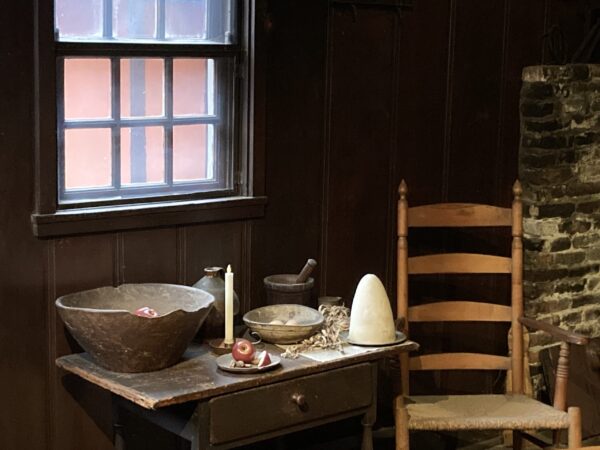
The Revere House kitchen today includes both real and replica foods to show what might have been cooking in preparation for fall and winter holidays. Note the cone of sugar on the right.
A syllabub was a popular fancy dessert. For a family like the Reveres, it might only have been enjoyed during the holidays. Syllabub consists of wine mixed with milk or cream. Early syllabubs were layered, which caused the cream to froth or curdle on top, giving the drink a layered appearance, but the recipes that were fashionable in the Reveres’ time were heavily whipped, sweetened with a bit of sugar, and eaten with a spoon[11]. Other common desserts consisted of custards, pies, and creams. The reader will notice that these dessert types have more fat than sugar, and this could be due to the high cost of sugar and the relative ease of sourcing butter and cream.
Cooking was definitely a more time-consuming project in the Revere’s time, and it required a lot more planning ahead than we need to do today. But just like us, the Reveres had plenty of flavor options for meals and desserts and they took advantage of what they had, when they had it. Certainly, Rachel spent a lot of time cooking, especially during the holidays! If you’re interested in learning more about the Revere House kitchen, see our previous blog post.
If you want to try your hand at colonial cooking, we have some great historical recipes here! (don’t worry, you can use a modern oven!)
[1] Louise Conway Belden, The Festive Tradition: Table Decoration and Desserts in America, 1650-1900 (W.W. Norton & Company, Inc., 1983), 108.
[2] Jane Nylander, Our Own Snug Fireside (Alfred A Knopf, Inc., 1993), 193-194.
[3] Rosana Wan, The Culinary Lives of John & Abigail Adams: A Cookbook (Schiffer Publishing, Ltd., 2014), 23.
[4] Nylander, Our Own Snug Fireside, 187.
[5] “Daily Fare and Exotic Cuisine in Mid-Eighteenth-Century Newport,” Marian Mathison Desrosiers, accessed December 10, 2025. https://newporthistory.org/wp-content/uploads/2020/05/May-15-desrosiers_Food.pdf.
[6] Alice Morse Earle, Home Life in Colonial Days (The Berkshire Traveller Press, 1974), 108-120.
[7] Nylander, Our Own Snug Fireside, 197.
[8] Belden, The Festive Tradition, 104.
[9] Using data from “Selected Prices 1750-1774.” The Value of a Dollar: 1600-1865, we can calculate the price of sugar from 18 pence in 1767 to $12.60 in 2002 USD. We can then use 80% inflation between 2002 and 2025 to calculate the price of sugar to be $22.68 in 2025 USD.
[10] David Freeman Hawke, Everyday Life in Early America (Harper & Row, 1988), 77.
[11] Belden, The Festive Tradition, 139.