
Curiosities From the Paul Revere Memorial Association’s Archives
This virtual exhibit showcases a collection of less-frequently displayed artifacts from the Paul Revere House’s collection. While none of these objects were ever located within Paul Revere’s North Square house, they each illustrate an angle of the famous Patriot’s life and ongoing story. The labels for this exhibit were written by interns in the Paul Revere House’s 2025 High School Internship Summer Program.
The images in this post are gallery style. Please click on an image to enlarge it!

Map of Boston
1775
printed for Town and Country Magazine
This map of Boston and the surrounding area was published by Archibald Hamilton and shows Boston’s landscape and conditions, including occupation by British soldiers in 1771.
Boston underwent multiple landfill projects, filling in marshes and tidal flats in the Back Bay and South Boston to create more usable land. In 1771, before these projects, Boston only connected to the mainland through a thin land bridge, “The Boston Neck,” guarded by British soldiers. Paul Revere, in 1775, left Boston by water, and went through Charlestown, avoiding soldiers at the Boston Neck.
Label by Theodore Jones

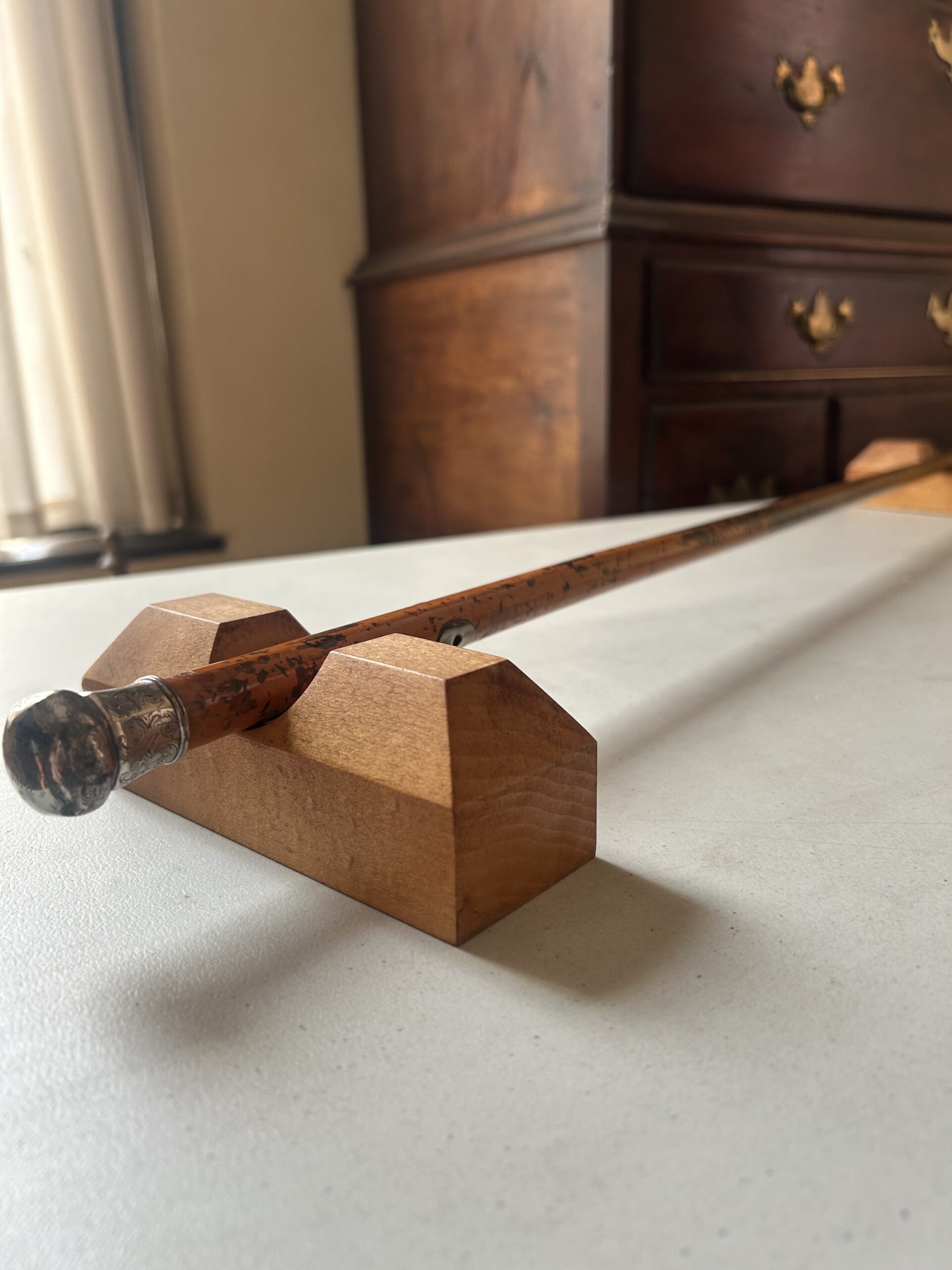


Revere Walking Stick
c.1800s
Donated by Lucretia Revere Reynolds
In colonial times, walking sticks were a symbol of status and wealth. This particular cane belonged to Paul Revere and remained with his family after his death in 1818, as marked by the engraving on the cane top. The artifact was ultimately donated to the museum by Lucretia Reynolds in 1947. She was the wife of John Phillips Reynolds Jr, a direct descendant of Revere, who is known for his purchase of the Paul Revere House therefore protecting it from developers in 1902.
Label by Maddie G. Lilley and Arabella V. Pelekoudas
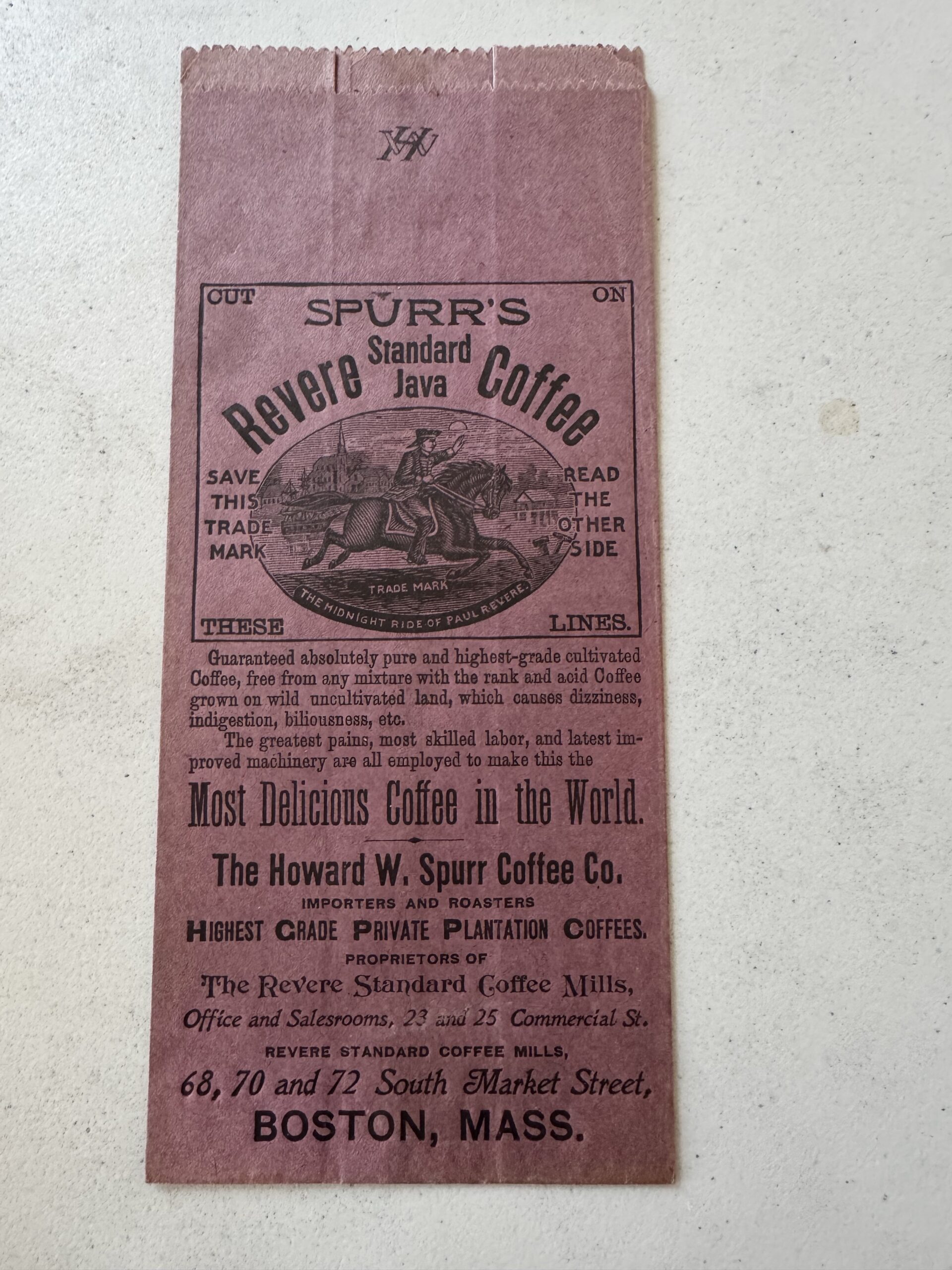
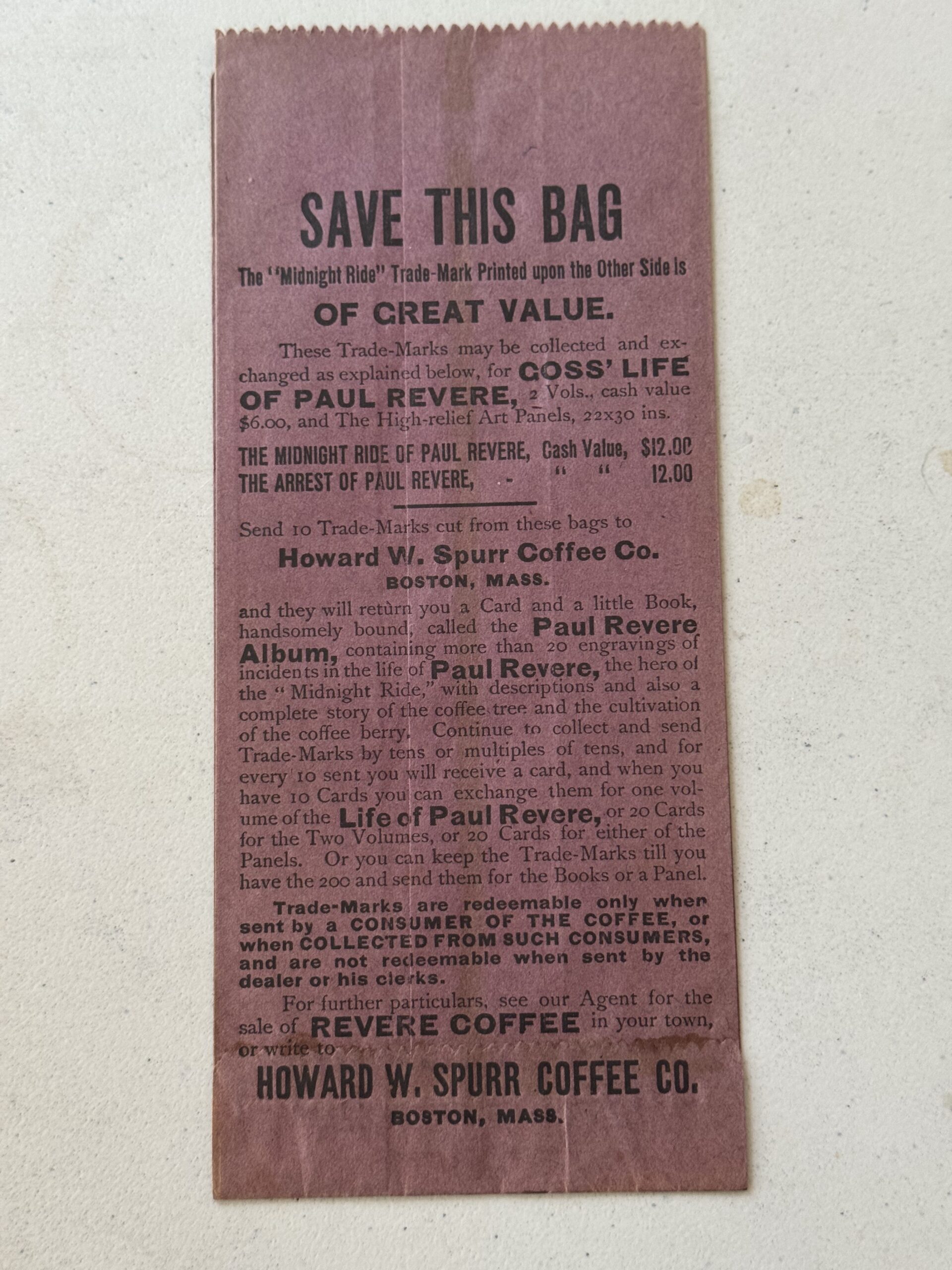
Spurr’s Revere Coffee Bag
Howard W. Spurr Coffee Co., Boston, MA
Circa 1884–early 1900s
Printed paper bag
This pink paper bag once held “Revere Standard Java,” a premium blend created by the Howard W. Spurr Coffee Company. “Revere Coffee” was named to honor American Revolutionary War hero Paul Revere, whose name, according to the company, symbolized “what is best in man wherever you find him.” The coffee was marketed as “the most delicious in the world” and sold using patriotic imagery, including Revere’s famous Midnight Ride. Customers were encouraged to save the bags and exchange them for books and collectible cards about Revere, an early example of loyalty marketing. This product blended everyday consumer goods with national pride, turning a morning cup of coffee into a celebration of American identity and history.
Label by Keyana Orcel


Video Camera
c. 1950
The Revere Camera Company, founded in 1939, sold this 8MM film camera in the 1950s. Originally from Chicago, IL, the company was founded by Russian immigrant Sam Briskin (born Shulem Boriskin), who fled to the United States to escape anti-Semitism. Briskin, who originally founded a radiator company, switched to camera making due to the growing popularity of movies and his desire to make home movies more accessible. His supposed inspiration for the name “Revere” came from Revere Copper and Brass, Inc., which had once provided materials for Briskin’s radiator company, and was linked to a business founded by Paul Revere in 1801. The camera once came with a wrist strap and camera case, and filmed two minute videos in black and white and color.
Label by Kimaya Tenzin and Veronica Kemmett


Paul Revere and the Raiders Album
1966
Known for their No. 1 hit song, “Indian Reservation,” and multiple Gold certified records —including the pictured album The Spirit of ‘67— Paul Revere and the Raiders brought a unique energy to 1960s pop-rock. Founded by Paul Revere Dick, the band leaned into its leader’s name and developed a brand defined by patriotism, famously donning tricorn hats and revolutionary-war style costumes. Their emphasis on the American identity and the American Revolution through the historical significance of Paul Revere served as a thematic counterweight to the rising influence of British musicians on the American music scene during the concurrent period known as the “British invasion.”
Label by Erin Campbell and Elena Zaganjori
The Paul Revere House museum has an extensive collection of artifacts, including many objects from during Paul Revere’s lifetime, and many later artifacts which illustrate how Revere’s story was later taken up and continues to be an important part of American folklore. This exhibit includes both artifacts (such as Revere’s walking stick) which have been with the museum since its founding to one artifact (the Revere Coffee Bag) which we acquired to the museum’s collection this past month. Due to our museum’s limited exhibit space, we are only able to display a small portion of our museum’s collection at any time. We are thankful to our fantastic interns for helping us share this small portion of it with you today!