
Fact-checking the CIA, or, the myth of “The Mechanics”
By: Tegan Kehoe
Several times, I have encountered the idea that Paul Revere was part of a spy ring called “The Mechanics,” and my knee-jerk reaction has always been that that’s wrong. As the Research Director at the Paul Revere House, part of my job is to investigate historical rumors about Revere. This blog post is a peek into my process when I want to check a fact about Revere’s life. In this particular research journey, I eventually ran into a dead end, which is what I suspected might happen, but where I hit that dead end surprised me.
Leading up to what’s now called “the Midnight Ride,” Paul Revere was in a group of Patriots who kept tabs on the movements of royal soldiers stationed in Boston. Interpretations vary about where that group fell on the spectrum between a neighborhood watch group and espionage. My colleagues and I feel that the group was not clandestine enough to be considered true espionage, but hearing it called a “spy ring” didn’t raise alarm bells for me. Most of the members of this group were likely also members of the Sons of Liberty and related groups. However, I never believed this particular network had a name, or at least not one that was recorded for posterity.
A couple of things about the name “The Mechanics” made me suspicious. First, it’s a memorable tidbit and I didn’t remember reading it in any of the more authoritative biographies of Revere. Second and more importantly, in Paul Revere’s 1798 description of the Midnight Ride, he says, “I was one of upwards of thirty, chiefly mechanics, who formed our selves in to a Committee for the purpose of watching the Movements of the British Soldiers.” At the time the word “mechanics” meant tradesmen or laborers; he’s referencing the social class of the people involved, which was a very normal thing to do in colonial Boston. My initial assumption was that someone misread this and took “mechanics” to be a code name. But at this stage, I was only going by what seemed plausible to me. A lot of historical research is about verification.
My first step with a question like this is to ask around. A great thing about a place like the Paul Revere House is we have several people working closely with the same slice of history, so getting a gut check is easy. I spoke with both our curator and our executive director. If one of them had said, “Actually, I do think the group was named The Mechanics,” our next step would have been to talk about why they think that and what source they found it in. Since my colleagues shared my hunch that this is a myth, I continued “asking” around, but this time I asked a couple of books.
Several important books have been written about Paul Revere’s life, each with a slightly different focus and written in a different context. For this question, I immediately looked to Esther Forbes’ 1942 biography, Paul Revere and the World He Lived In, which has the frustrating quality of being based on very thorough research that was not well cited. I also looked to David Hackett Fischer’s 1994 Paul Revere’s Ride. This book is the closest thing there is to a single definitive history of Revere’s Midnight Ride, although Fischer’s interpretation of a few details does not match Revere House staff’s interpretation. Neither Forbes nor Fischer call Revere’s group “The Mechanics,” but they also don’t mention anyone erroneously calling them that. I checked the other biographies of Revere we go to regularly, with the same result. I rechecked the 1798 letter for clues, but it didn’t yield anything beyond the line I quoted above.
I was curious to see if I could find the earliest time someone wrote that Revere was in a group called “The Mechanics.” Ideally, I would go to a source that shared this idea and see what it cited in order to start to trace a paper trail backwards. I did an internet search for “Paul Revere spy ring the mechanics” and various other keyword combinations and found over a dozen articles, Facebook posts, and forum posts repeating the idea that the group was named “The Mechanics.” The idea was also in Google’s AI summary, naturally, because it was in so many articles and AI tools don’t evaluate whether the sources they summarize are accurate. The sources I found were types that historians don’t consider reliable – certain popular history websites, listicles from entertainment sites, and sites self-published by people who are not established historians. There were also history articles on the websites of organizations with expertise in something unrelated to history – I found this story repeated on the website of a law firm, for example! None of these types of source are inherently bad, but since these sources are less likely to be vetted for historical accuracy, they are where a lot of myths circulate. Few of these articles cited their sources, but I was pleased to see that several articles did at least describe their source – and surprised to see some of them say they got their information from a report put out by the CIA.
Cue a lot more searching with different combinations of keywords, and I found four items I thought might be of interest. I read them all for clues. One was a blog written by a former US Army intelligence officer who now writes historical spy fiction – but it was too recent to be the origin of the story. Another was a now-declassified CIA publication from 1960 which contained a review of a book about the history of military intelligence in the American Revolution. I thought this was going to be my lead. The report was declassified in 2005; what if the spy blogger or a similar enthusiast had been tracking what was newly available from the CIA’s archives and encountered the “Mechanics” idea there? However, neither the review nor its subject (Turncoats, Traitors and Heroes by John Bakeless) contained the idea that “The Mechanics” was the name of the group.
One of the other documents was a PDF on the history of military intelligence in the Revolution, seemingly for a general audience. This one did say that the Revere’s group was named “The Mechanics.” I couldn’t find anything about the document’s origins except that it was created by the CIA sometime in the mid-90s. It was my earliest source so far. The next source I checked, though, was a blog post that extensively quoted the records of the Church Committee hearings. Now I was getting somewhere.
In 1975, the United States Senate created a committee to investigate abuses by the CIA, FBI, NSA, and IRS. Known as the Church Committee, it was part of a larger series of investigations into the US intelligence system at the time. The Director of the CIA at the time, William Colby, testified in front of this committee, and as an introduction to his testimony, he offered some bicentennial reflections on the role of military intelligence in the Revolution. Colby said, “The first known American intelligence net was established by Paul Revere. Thirty persons were assigned the job of reporting on British troop movements in Boston and performing occasional sabotage. The members of this net were known as the ‘mechanics’ because of their technical skills.” It’s not clear whether Colby was referring to the men’s skills in their trades, or whether he thought “mechanic” referred to skill at spycraft, but he definitely missed that “mechanic” was a description of the men’s social class and not the name of the group.
Colby also went on to claim that a particular bill Revere sent during the war was the first covert action voucher (a document used for expenses during secret missions), but this much-less-catchy tidbit has not become widespread. Colby’s historical reflections did not make it into the final report of the Church Committee, but they were part of the official record of the hearings.
After finding this blog post and a digitized version of the record it was quoting, my task was to figure out whether there were earlier expressions of this idea that the group was named “The Mechanics.” The process got more mundane again. One doesn’t usually cite sources in a spoken presentation, let alone when history is the preamble and not actually the meat of what’s being shared, and sure enough, Colby didn’t say where he got this idea. I continued looking for earlier sources, including books and articles about Revere and about early American spy networks. I also searched sources from Revere’s lifetime and the generation after him to try to make sure there wasn’t an early mention of The Mechanics that I missed. I didn’t get anywhere.
I feel fairly confident that I achieved my original goal: to get as close to as I could to certainty about whether Revere’s network was named “The Mechanics.” In history, as in many other fields, is rarely possible to prove a negative. As I suspected would happen, I didn’t find an answer so much as I researched until I could satisfy myself that I had checked all of the places I would expect to find one. Now I’m able to say that we have no reason to believe that the spy network was named “The Mechanics.” While Revere called the participants “mechanics” in a letter, this term was widely understood at the time to mean “artisans.” The earliest instance we know of in which the group was referred to as “The Mechanics” was two hundred years later. That could always change if we find an earlier use (or a reader of this blog is able to bring one to our attention!), but that’s a large part of the process of history research: interpreting the facts based on the documentation we have.
I’m interested to know whether Colby was the origin of the myth, but it’s not likely that I ever will. I enjoy speculating that Colby read the review of the Bakeless book in the CIA journal sixteen years before. Maybe he even picked up the book, but then misinterpreted that detail! Still, this is pure conjecture. He may just as easily not have been the origin of the misunderstanding, and I just haven’t found an earlier source. For now, this is going to remain a mystery, but I advanced our knowledge of the subject a little bit, and got a story out of it.
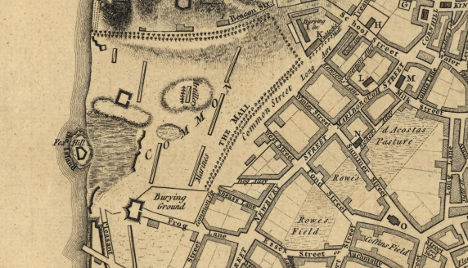
Detail of a 1775 map of Boston, showing Boston Common, which was one of the places soldiers who Paul Revere watched were based.
Two postscripts about the practice of history:
First, I mentioned that historians tend not to give credence to self-published articles unless the authors are recognized historians. However, there are some situations where it’s essential to pay attention to historical research by people who do not have recognition granted by academia or mainstream publishing. While a lot of progress has been made, these fields still have some systemic biases, so sometimes the best historical research is done by people without formal credentials, written for, by, and about members of a particular marginalized community.
Second, if you are a history enthusiast, student, or early-career professional, it can be easy to see people make mistakes like thinking “the mechanics” was the name of the group and come away feeling nervous. Entering a field like history, it can seem like you have to know everything about your chosen area before you start contributing to it, to avoid spreading a history myth. Of course, that’s impossible to do, but luckily it’s also not necessary. Established historians do make mistakes and even catch one another’s mistakes. Sloppy mistakes can hurt your reputation, but it’s often possible to avoid those by doing the same kind of asking around I described here. Getting context from other historians, whether they are people you know or people you read who leave a paper trail of citations, makes it possible to do history well without being omniscient.
Tegan Kehoe is the Research and Adult Program Director at the Paul Revere House.