
Exploring the Greenway’s Newest Mural: Rixy’s The Midnight Ride
By: David Gain
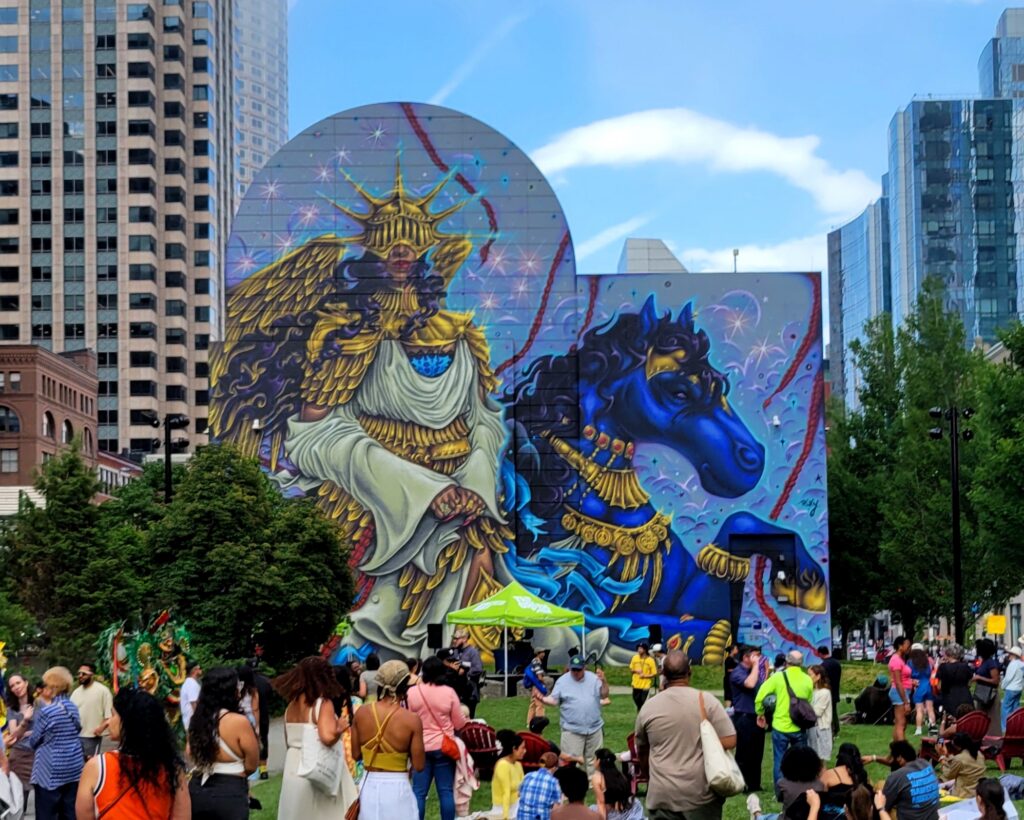
Rixy’s The Midnight Ride will be on view in Dewey Square from June 2026 to May 2027.
Over the past couple of months, a lone figure has stood atop an aerial lift in Boston’s Dewey Square. Equipped with cans of spray paint and a vision, Roxbury-born artist Rixy has turned the 76-foot wall on the Greenway into a vibrant symbol of the 250th Anniversary of American independence. For the next year, her towering express rider will look out onto the city where the revolution began, delivering a powerful message for the next 250 years.
The Rose Kennedy Greenway Conservancy announced in April that it had chosen Rixy Fernandez (who goes by the mononym Rixy professionally) from over 120 submissions in the Greenway’s first open call for artists. Rixy’s work, titled The Midnight Ride, marks the 11th mural since the Dewey Square Mural project launched in 2012, and the first led by an all-female muralist team, with Rixy accompanied by artists Ayana Mack and Sagie.
The Revere House became involved in the mural process when we reached out to the project, offering to provide any support the team might need. Rixy, as well as Martha Swann-Quinn and Audrey Lopez of the Greenway Conservancy, joined us at the Paul Revere House soon after to share the mural’s design. The Revere House is no stranger to the ways Revere’s legacy intersects with contemporary art – through prior on-site collaborations with artists Laura Baring-Gould, Michael Dowlings, and Niho Kozuru – so we were excited to see how the Midnight Rider would resonate with yet another artist’s vision.
Rixy explores the legacy of the Ride and the Revolution in her own fantastical style, blending the ordinary with the magical. Preferring to work in the immediacy of aerosol-based paints, her mural brings to mind the hyper-saturated vignettes of street artist Lady Pink mixed with the engaging female figures of portraitist Amy Sherald.[1]
The Midnight Ride, in the spirit of all the public art along the Greenway, encourages us to appreciate art through conversation, history, and community. By asking questions about what we see, delving into the past, and engaging in dialogue in shared spaces, we have the opportunity to learn more about ourselves and our nation during this important anniversary.
To that end, let’s start with the obvious: What does the mural show?
The Midnight Ride depicts a rider, dismounted from her horse to deliver a message. She is dressed in flowing robes accented with golden armor with a visor disguising the top of her face. Along with her dark blue horse, bedecked with luxurious necklaces, the two face out onto the Greenway for thousands of Bostonians to see each day.
As a public mural, this artwork is displayed in tandem with the natural and built environments of downtown Boston. When thinking of the 250th Anniversary of American Independence, we must also consider the much longer history of Massachusetts. The Greenway’s land acknowledgement highlights the historical and ongoing presence of Indigenous communities, referring to the ancestral homelands and waterways of the Massachusett and Pawtucket, as well as the neighboring Wampanoag and Nipmuc peoples’ stewardship of the land.
The Greenway Conservancy states that as a “land-based organization, we recognize that the land and waterways are older than we are and pay honor and respect to this history and to this land, these communities, their Elders and all past, present, and future generations.”[2] The history of this land and its people extend back centuries, carried forward by oral histories and tradition.
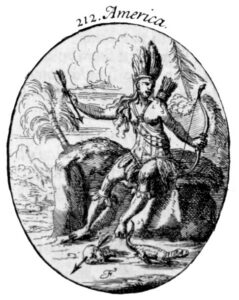
Etching of the allegorical America by Isaac Fuller. While Fuller’s print comes from a 1709 edition of Iconologia, his work is based off Ripa’s original 1594 description of the Americas.
While the personification of places and ideals have existed since the first created artworks, the most influential depiction of an allegorical America stems from Cesare Ripa’s Iconologia. Published in 1593, Ripa codified the emerging thought that the Americas would appear as an Indigenous warrior, her chest bare and her bow at the ready.[3]
The first Massachusetts seal, as determined by King Charles I in 1629 for the newly chartered Massachusetts Bay Colony, followed in this tradition by featuring an Indigenous man with a bow as its central figure.[4] Massachusetts, so named for the Indigenous nation who acted as stewards of the land for generations before English settlement, maintained a symbolic connection to its original peoples, even after arriving British settler-colonists encroached upon the land with treaties and disease.
Rixy’s mural draws on this established iconography—the female warrior of color—but she has garbed and gilded the figure, granting her a golden crown and talons of acrylic nails in the artist’s signature blend of fantasy and reality. Her helmet is pulled low under her brow, a visor to gaze backwards into time.
Who is she?
More than just incorporating early depictions of the Americas, Rixy has tapped in the visual language of two major artistic figures: Liberty and female warriors. The allusions to the Statue of Liberty are abundant, with her Greco-Roman tunic and rayed crown. The largest departure lies in her armor and helmet, with the latter obscuring her vision like the blindfolded Justice. Her armored appearance is reminiscent of both winged Norse Valkyries and the gold-clad visage of Oshun, a Yoruba orisha (divine spirit). A direct influence for Rixy was the imposing image of Elenda, a character from the trading card game Magic: The Gathering.[5] Drawing upon her love of the fantastical, Rixy has pulled the image of trading card game’s vampiric knight down into reality, blending the outfit with the feathers and flair common during Carnival celebrations in the Caribbean.
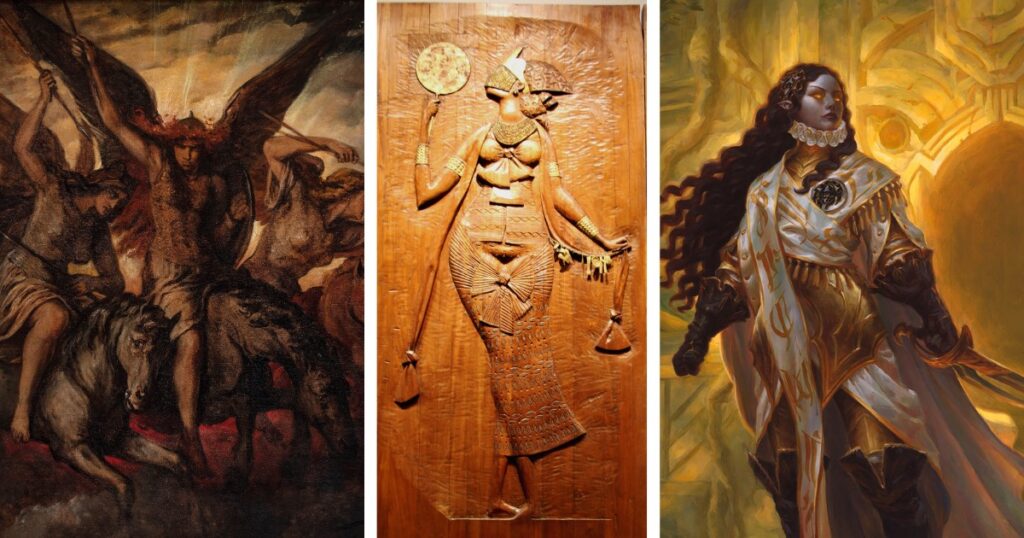
From left to right, details of: Valkyries (1871) by Elisabeth Jerichau Baumann; Oxúm (Oshun), part of the 27 panel Mural dos Orixás (1968) by Carybé; Elenda, the Dusk Rose (ca. 2018) by Chris Rahn for Magic: The Gathering, © Wizards of the Coast.
This combination of elements creates an otherworldly protector, one that is neither exclusively warrior nor nurturer. Instead, she is a messenger dismounting her horse to speak with you directly.
What message does she deliver?
The silent figure will not respond when asked, so we must look to the plethora of symbols that both adorn and surround the rider and her companion: the horse. Rendered in ethereal blue, the steed evokes the image of Babe, the giant blue ox accompanying the folkloric Paul Bunyan.
Instead of a standard bridle, regal necklaces hang from the horse’s neck, dripping with jewels and golden tokens. Engraved into the hanging charms are the initials A, S, and R (for the artists Ayana, Sagie, and Rixy respectively) as well as several symbols, including a peace sign and the Adinkra sankofa. With the sankofa, we begin to see the full intent of Rixy’s mural.
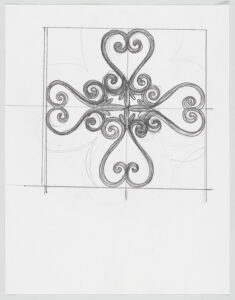
Sketch of the “Sankofa” fabric design (1997), designed by Male Djenaba Barnett for Afritex Ventures. Collection of the Smithsonian National Museum of African American History and Culture, Gift of Malene Djenaba Barnett, © Afritex.
The Adinkra consists of a large range of symbols historically created by the Akan peoples of Ghana and Côte d’Ivoire to depict complex concepts and principles. Many of these symbols traveled with captives of the trans-Atlantic slave trade from West Africa to the American colonies and Caribbean. In particular, the symbol employed by Rixy is often found on wrought iron gates of America’s southern states, where both enslaved and freed craftspeople echoed this visual language in the built environment.[6]
The heart shape formed from two mirrored sankofa means “looking into our past to learn for the future.”[7] This sentiment is at the core of Rixy’s mural, incorporating elements of the many cultural groups that have called America home in its centuries-long history. In the same way that Frida Kahlo embedded Aztec and Zapotec symbolism into her artwork, Rixy incorporates these elements not only in the mural’s central figures, but in the background as well.[8]
Shimmering around the rider and her horse are thirteen stars, referencing early American flags with the number of original colonies. The brightest star at the zenith, above the rider’s head, symbolizes the North Star, which was used by Underground Railroad operatives like Harriet Tubman as a wayfinder, guiding self-emancipated individuals away from a life of enslavement. Inspired by this visual tool, Frederick Douglass chose the North Star for the name of his 19th-century Abolitionist newspaper as a symbolic reference.[9]
The thirteen stars are joined by a long ribbon of red silk. Rixy’s inspiration comes from the symbolic red thread popular in Chinese and other East Asian beliefs, specifically the red thread of fate that connects the lives of lovers, families, and friends. In this way, Rixy is echoing the long history of Chinese laborers in the creation of America, including the over 12,000 railway workers recently added to the Department of Labor’s Hall of Fame in 2023.
In this way, Rixy is in the company of Jasper Johns and Laura Aguilar, deconstructing the American flag while maintaining its visual identity. However, unlike Johns’s collage of encaustic stars and stripes, which confronts and complicates the symbol,[10] Rixy’s use of the individual components allows the flag to include a wider range of American experiences. Each point to a more robust history of this nation, one that is built on networks, communities, and peoples joining together to achieve a common, greater cause.
If Rixy’s messenger is part of a larger history of revolutionary and community activism, then we have to ask: Who are the other riders?
Paul Revere was not the first person to ride for a cause in America, nor was he the last. The history of this country is filled with individuals who took up the mantle of rider to further liberty and justice, as Henry Wadsworth Longfellow mythologized in his telling of the Midnight Ride. Not even Revere rode alone. In his written accounts, Revere named William Dawes and Samuel Prescott as additional riders, and called attention to the network of working-class artisans – “chiefly mechanics” – whose surveillance of British soldiers tipped off the Patriot forces in the first place.[11]
This level of large-scale organization often comes at a cost; namely the anonymity of the individual in favor of the unified gestalt. However, the lack of names in no way diminishes the contributions of the many. As Rev. Horace Bushnell said to honor the nameless ‘Queens of Homespun’: “Who they are by name we cannot tell—no matter who they are—we should be none the wiser if we could name them, they themselves none the more honourable.”[12]
Bushnell was referencing the women whose tireless involvement in the physical creation of textiles and homemaking shaped a pre-industrialized American identity. While Bushnell focused on the roles of white women in the early Colonial and Federal periods, his observation extends to both enslaved and freed craftspeople, day laborers, and immigrant mill workers whose labor allowed this new nation to thrive.
While it would be theoretically possible to delve into the archives to unearth the names of Bushnell’s heroines, the same cannot be said for the thousands of people whose labor was deemed more worthwhile than their lives. Whether they existed outside the system of record keeping or their contributions were purposedly unrecorded or removed, their names are left forever unknown. This is why Rixy’s mural feels particularly timely, as her work combines the visual language of many different communities all striving to gain the common cause of freedom, all while acknowledging the hardships of the American past. As the use of a sankofa implies: critical examination of the past is required to bring about a better future.
Rixy is taking part in a technique that historian Sadaya Hartman has termed ‘critical fabulation.’ Coming from the Latin “fabula” meaning story, the technique explores historical events and people through alternative points of view, forcing the reader (in Rixy’s case, viewer) to challenge the established notions of history and its tellers. As Hartman explains, the approach “weaves past, present, and future” to retell stories of “an unrecoverable past,” whose purpose is “not to give voice […], but rather to imagine what cannot be verified.”[13] This technique allows for new ways to engage with the legacy of slavery—Hartman’s original intent for the approach—although it applies to many marginalized communities whose voices were expunged from archival records.
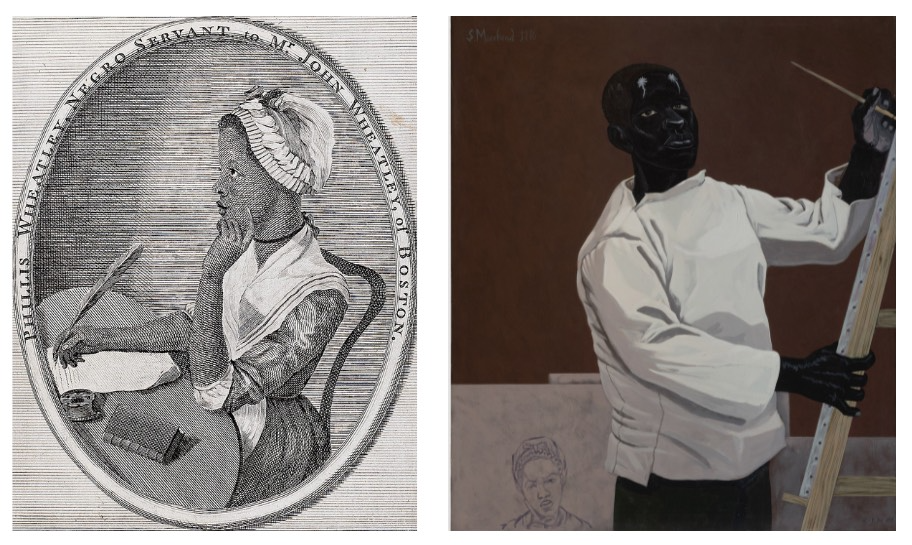
Boston poet Phillis Wheatly wrote the name of enslaved artist Scipio Moorhead in the margins of an early printed copy of her poem, “To S.M., A Young African Painter, on Seeing His Works.” This marks one of the only references to Moorhead in recorded history. As none of Moorhead’s artwork survives today, contemporary artist Kerry James Mashall imaged the enslaved artist in his studio.
From left to right: Engraved frontispiece to Phillis Wheatly’s Poems on Various Subjects, Religious and Moral (1773), based on a portrait by Scipio Moorhead; Kerry James Marshall’s Scipio Moorhead, Portrait of Himself, 1776 (2007), Collection of David Zwirner.
Rixy’s depiction of a dark-skinned protector as the midnight rider is not an attempt to conflate the image with that of Revere’s or to rewrite his presence; it is to position the contributions of thousands of faceless Americans alongside the heroic Paul Revere in the public consciousness.The image of Revere—the artisan at the worktable immortalized by John Singleton Copley—often jumps to mind when hearing the Midnight Rider’s name, but there is no readily recalled portrait of the countless unknown contributors to the American Revolution, particularly women and patriots of color. However, there is great power in creating a symbol that allows people to see themselves. As feminist historian Emily Teipe writes on the identity of Revolutionary folk hero Molly Pitcher: “As female veterans returned to a patriarchal society where their contribution went unrewarded and largely unrecognized, only the heroic imagery of Molly Pitcher commemorated their patriotism.”[14]
Rixy’s midnight rider serves the same purpose, providing a synthesized emblem for marginalized communities in American history, chief among them women of color. However, Rixy has spent considerable time incorporating elements into the piece that involve other cultural groups, creating a symbol that reflects multiple communities.
For the next year, Rixy’s The Midnight Ride will greet Bostonians and travelers alike. Gazing up at the over 70-foot-tall messenger in Dewey Square, you feel that she is not simply looking at you, but simultaneously into America’s past and towards its future. Here, caught at the nexus of Revolutionary heroes, America’s unnamed contributors, and community art, Rixy and her midnight rider leave us with one final question, albeit one we must each answer alone:
How will you answer the call?
[1] In particular, Rixy’s The Midnight Ride shares many similarities with Sherald’s Trans Forming Liberty (2024) in subject matter and approach. Both artists reinterpret an American historical figure through a modern lens, or as Sherald sates: “Liberty isn’t fixed. She transforms, and so must we. This portrait is a confrontation with that truth.” Francesca Aton, “Amy Sherald’s ‘Trans Forming Liberty’ Graces the ‘New Yorker’ Cover,” ARTnews.com, August 4, 2025, https://www.artnews.com/art-news/news/amy-sherald-trans-forming-liberty-the-new-yorker-cover-1234748747/.
[2] The Rose Kennedy Greenway, “Land Acknowledgement” (Rose Fitzgerald Kennedy Greenway Conservancy, February 23, 2026), https://www.rosekennedygreenway.org/art/.
[3] Ripa’s personifications build on the “Four Continents” perspective popular in Europe at the time. The world consisted of four distinct regions: Europe, Asia, Africa, and the Americas. As these depictions are popularized by European authors and artists, it is important to note that each allegorical figure was depicted through a European gaze; for example, even while the earliest sets of the “Four Continents” depicted the regions in a stereotypical manner, they were almost all depicted as being white. Freyda Spira, “Allegories of the Four Continents,” Metmuseum.org (Metropolitan Museum of Art, March 1, 2021), https://www.metmuseum.org/essays/allegories-four-continents.
[4] Secretary of the Commonwealth of Massachusetts, “The History of the Arms and Great Seal of the Commonwealth of Massachusetts,” Sec.state.ma.us, 2024, https://www.sec.state.ma.us/divisions/public-records/history-of-seal.htm.
[5] Rixy shared her influence with the community during an artist meet-and-greet event in Dewey Square on May 21, 2026, hosted by the Rose Kennedy Greenway Conservancy.
[6] Waltrina Kirkland-Mullins, “Breaking down Fences — Revealing the Past,” in Curriculum Units, vol. III: Pride of Place: New Haven Material and Visual Culture (Fellows of the Yale-New Haven Teachers Institute, 2008), https://teachersinstitute.yale.edu/curriculum/units/files/08.03.03.pdf.
[7] African Burial Ground National Monument, “SANKOFA,” www.nps.gov (U.S. National Park Service, November 10, 2015), https://www.nps.gov/afbg/learn/historyculture/sankofa.htm.
[8] Janice Helland, “Aztec Imagery in Frida Kahlo’s Paintings: Indigenity and Political Commitment,” Woman’s Art Journal 11, no. 2 (Autumn 1990,, https://www.jstor.org/stable/3690692.
[9] “The North Star” in The Abolitionists, Documentary (PBS, 2013), https://www.pbs.org/wgbh/americanexperience/features/abolitionists-douglass-published-north-star/
[10] Nan Rosenthal, “Jasper Johns (born 1930)” in Heilbrunn Timeline of Art History, Metropolitan Museum of Art (October 2004), http://www.metmuseum.org/toah/hd/john/hd_john.htm.
[11] Revere stated he was a member of this network: “I was one of upwards of thirty, cheifly mechanics, who formed our selves in to a Committee for the purpose of watching the Movements of the British Soldiers, and gaining every intelegence of the movements of the Tories.” Letter from Paul Revere to Jeremy Belknap, circa 1798, Massachusetts Historical Society, https://www.masshist.org/database/viewer.php?item_id=99
[12] Note that historian Laurel Thatcher Ulrich pushed against Bushnell’s approach, stating that it “freez[es] people into a collective anonymity that denies either agency or the capacity to change.” In viewing incomplete archival records, it is easy to escribe an amorphous, vague group of people to stagnant ideals which limit nuance. Both Bushnell’s quote and Ulrich’s rebuttal can be found in Laurel Thatcher Ulrich’s The Age of Homespun: Objects and Stories in the Creation of an American Myth (New York: Vintage, 2002), pp. 15 and 20.
[13] Saidiya Hartman, “Venus in Two Acts,” Small Axe 12, no. 2 (July 17, 2008), p. 12, https://muse.jhu.edu/article/241115.
[14] Emily Teipe, “Will the Real Molly Pitcher Please Stand Up?,” Prologue vol. 31, no. 2 (Summer 1999), https://www.archives.gov/publications/prologue/1999/summer/pitcher.html.
David Gain is the Curator at the Paul Revere House.