
Rachel Revere’s Ring: An Exploration of Early American Jewelry-Making in Boston
By: Isabelle Ackerman
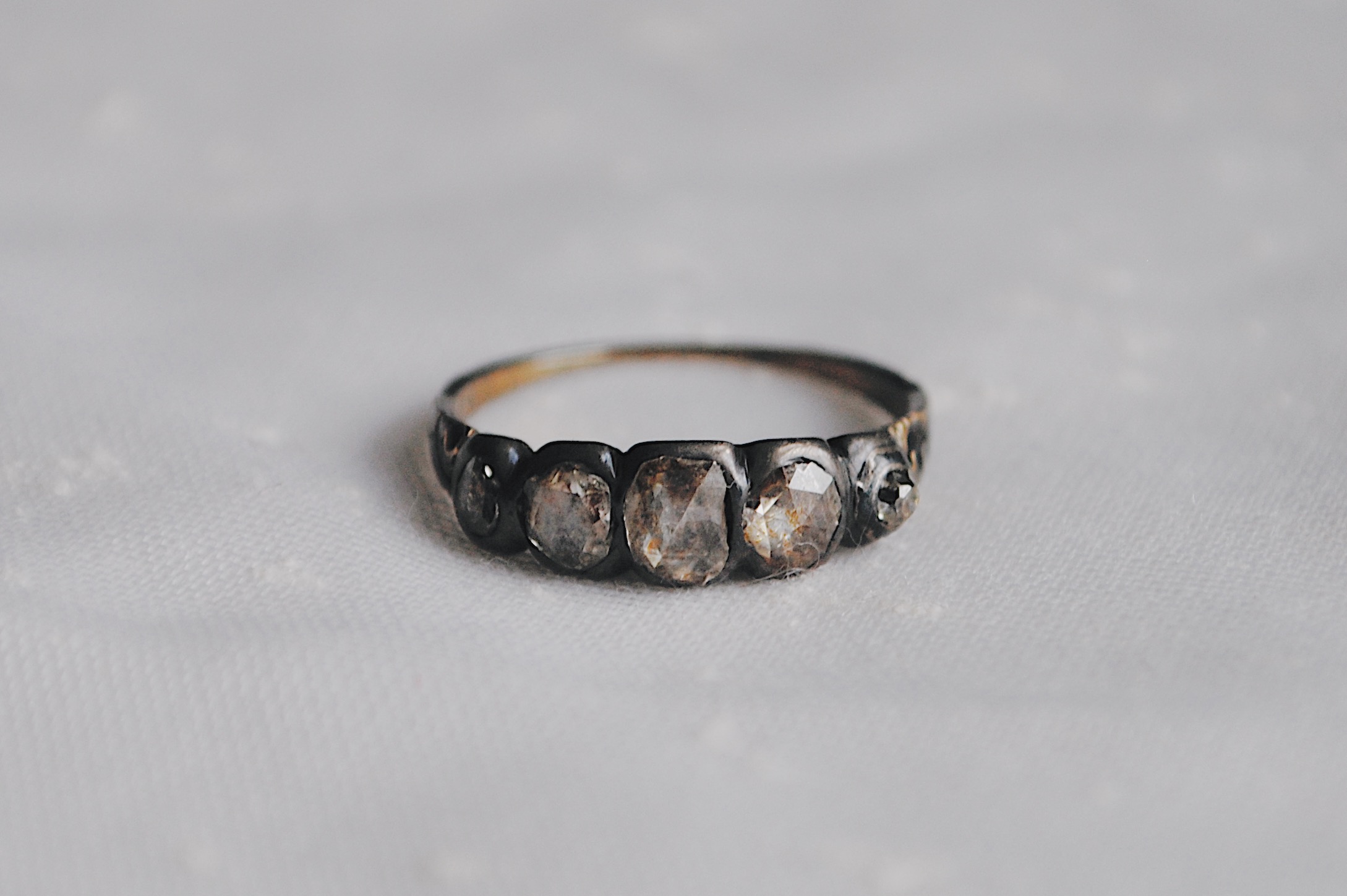
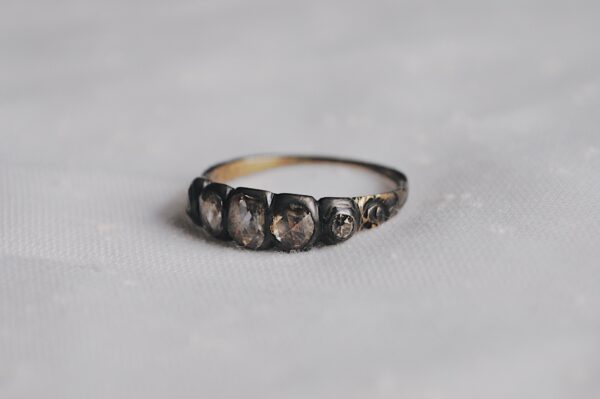
Rachel Revere’s ring in the collection of the Paul Revere House. Gift of Rachel Revere Coolidge Kimball.
A fascinating piece of jewelry in the collection at the Paul Revere House suggests a number of interesting questions about a larger story of consumerism and artisan work in late 18th- and early 19th-century Boston.
The ring, thought to be worn by Rachel Revere (Paul Revere’s second wife), is gold with silver accents, with five clear stones in a silver setting. The piece, acquired by the Revere House in 1984, was donated by Rachel Revere Coolidge Kimball, a great-great-granddaughter of Paul and Rachel Revere. Even before learning the history and story of craftsmanship behind the ring, I was moved by one simple observation: it is strikingly beautiful.
My name is Isabelle Ackerman, and I am a museum interpreter in my first year at the Paul Revere House. I have a background in art history and a particular interest in material culture – the objects we use, wear, hold close to our hearts, and what they mean to us – and I was hungry to learn more. A legacy object, an old file, and a slew of tantalizingly unanswered questions: my task, mostly spurred by my own curiosity and the generous sharing of knowledge by staff at the Revere House, was to dive deeper and learn more about Rachel’s ring.
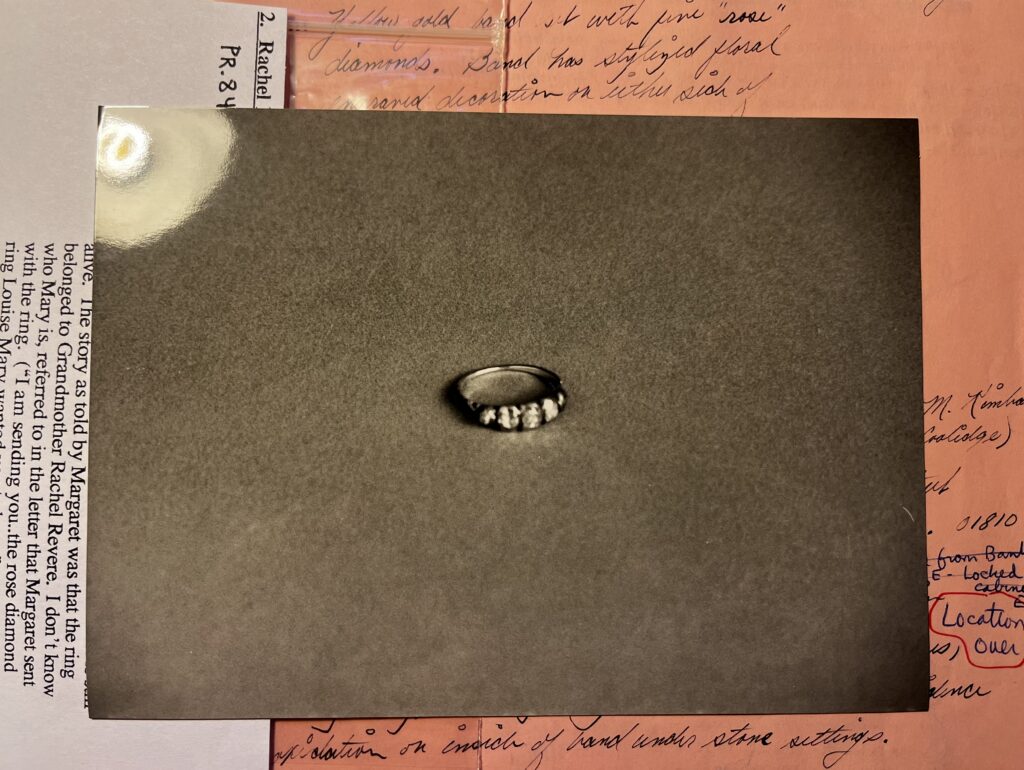
Rachel Revere’s ring, in an image from its collections file
The object file was handwritten in 1984 on a sheet of coral-pink paper, bearing marks of multiple different hands’ notes and observations. Upon first glance, it contained more questions than answers: a reference to the gems as “diamonds” – written in the file with quotation marks – and a cautious attribution of the ring as “early 19th c?” and “English (?)”. We had our work cut out for us.
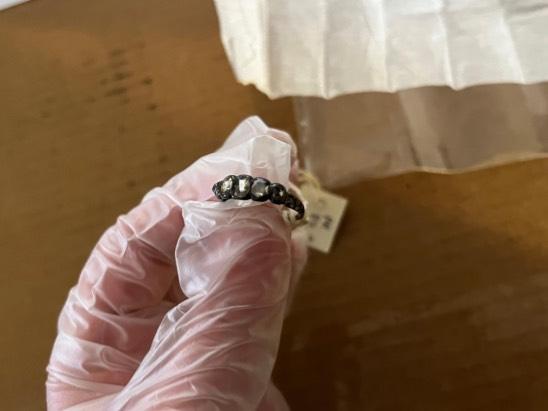
Examining Rachel Revere’s ring in collections storage.
Of particular interest to me were the stones – I had never seen any gems refract light the way that they did. Upon digging deeper into colonial jewelry history, and becoming familiar with the styles of the time, I was curious about whether the stones were paste or genuine diamonds. Paste diamonds, a technologically-advanced alternative to naturally-occurring diamonds, were extremely popular in early America, as well as in cosmopolitan places like London and Paris, where many trend-chasing colonists turned for adornment inspiration. If, indeed, the stones were paste, they would not have indicated that Paul Revere was being cheap if he bought artificial diamonds for his wife – he would have actually been quite fashion-forward in his selection. Georg Friedrich Strass, the inventor of paste diamonds (a new take on paste gem technology, which had been around since Greco-Roman times), was in high demand with important clientele, including King Louis XV of France.[1] Of course, artificial diamonds were, and still are, significantly less expensive than naturally occurring stones. Yet, for these 18th-century buyers, cost did not necessarily denote an item to be of lesser quality or interest. Many buyers, like the king of France and his court, and possibly even Revere himself, who was a craftsman in his own right, might have been curious and excited about the advent of a new scientific technology. Paste diamonds represented something new, something novel, something beautiful.
In order to find out more about the stones, David Gain, curator of the Paul Revere House, and I visited our neighbors at the North Bennet Street School, a vocational school in the North End. Tracey Jenkins Darji, jeweler and Department Head of the Jewelry Making & Repair program at the school, kindly agreed to help us dig into the puzzle of Rachel’s ring. First on the docket was determining the authenticity of the stones. Jenkins Darji used a diamond tester[2] to examine each individual gem on our ring, and each registered as a true diamond. Additionally, she was able to identify that the ring – and diamonds – showed signs of heavy wear, and that one of the stones, a smaller diamond, had been replaced within the ring’s lifetime. This immediately opened up interesting questions.
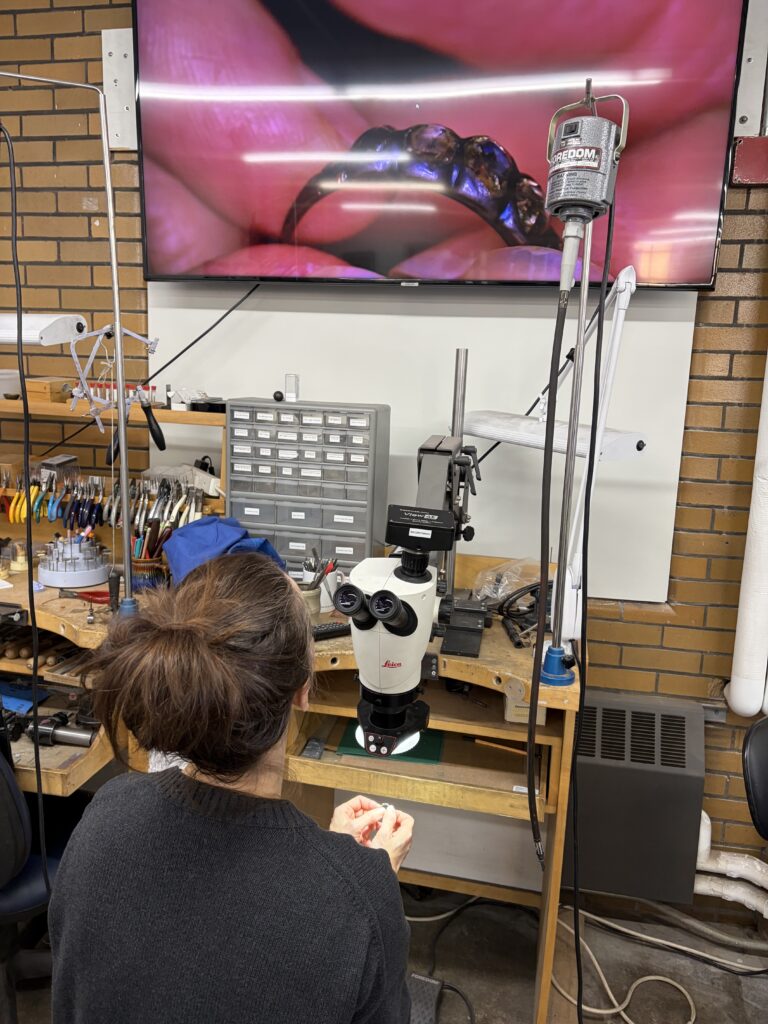
Tracey Jenkins Darji examines Rachel Revere’s ring under a loupe.
Jenkins Darji then took us into the work area, where she was able to examine the ring under a loupe hooked up to a camera to magnify the stones. Four of the five stones were cut in the rose cut style, an older cut where the diamond is shaped with a domed top and flat bottom. The fifth stone, one of the smaller accent stones on the end of the line of diamonds in the setting, is cut in the old mine cut style, in which the diamond is shaped with a flat top and bottom. The two types of cuts produce different prisms by which light is bent, therefore creating different patterns of shine and sparkle. Stones cut in a rose cut style are specially faceted to throw light in a way that is uniquely suited to perform well under conditions of low light or under candlelight – conditions that this ring certainly would have been worn in when it was first owned by Rachel Revere. We can imagine the ring being worn in the Revere House’s best chamber catching softly sputtering light at the card table. While not as flashy as 21st-century brilliant cut diamonds or multi-carat stones, the craftsmanship of Rachel’s ring is alluring in its simplicity. Today, most gemstones are cut to reflect electric or LED lights. Antique and vintage cut gems are not, which makes viewing them under contemporary lighting conditions a unique and notably ahistorical sensory experience. Rachel Revere’s ring is fascinating to our contemporary eyes because it appears to us to be imperfect: it is so different from the blinding white diamonds and flawless platinum bands that you might expect to see at a jewelry counter today. The ring has clearly been hewn by human hands, and bears the marks of tools and age. In the dark, or under flame, it takes on a softness and understated sparkle that would have been attractive and especially dazzling in the indoor lighting conditions of her day. When looking at it today, we need to use our imagination to picture how it might have appeared when Paul Revere gave it to Rachel Revere: beautiful.
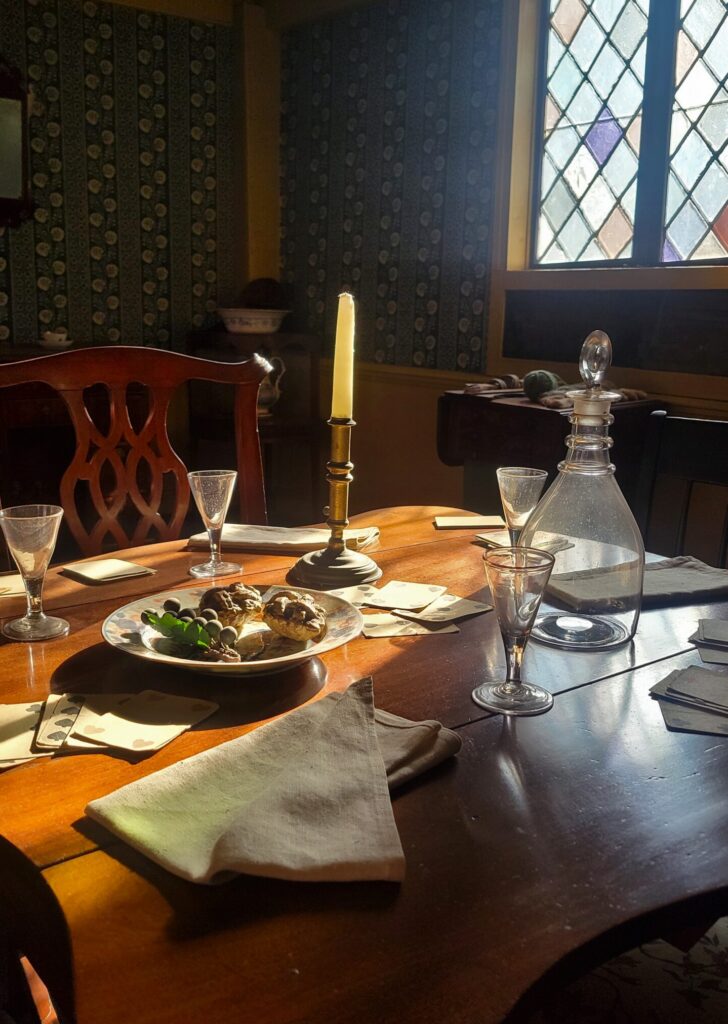
The house’s best chamber, as it is interpreted now, at dusk.
Old mine cut stones, like rose cut stones, sparkle elegantly under low light, but the different style indicated to Jenkins Darji that the smallest diamond was not original to the ring. Mine cut diamonds, a newer cut than rose, were more expensive than rose cut diamonds in the era in which Rachel’s ring was made, and peaked in popularity in the mid-19th century. The intention with a mine cut diamond is to keep the actual surface of the stone as large as possible – the name derives from the fact that they were cut simply, sometimes roughly, and immediately after mining, often by hand as soon as they had been extracted (in the case of the replacement diamond, possibly in India). For us, this likely means that the ring was well cherished by later wearers in the family, and the tiny mine cut diamond gem was replaced after such wear, some generations after Rachel.
Under high magnification, the finer details of the ring’s craftsmanship are clear. The band is a deeply blackened gold, similar to a popular Federal period finish called “dead gold,” which involved jewelers using an intentionally-aged patina that evoked antique jewelry.[3] The black-gold of Rachel’s ring could be from these intentional antiquing techniques, a result of generations of wear, or some combination of both. As for the making of the band, Jenkins Darji suggested that it was a low-carat illusion band, likely done using an ancient technique called fire gilding. Put simply, fire gilding involves the process of combining mercury and molten gold in a mortar and pestle to create a sort of slurry to gild a surface with – the silver band of the ring. As fire gilding is a technique that has been practiced since at least the 2nd century CE,[4] we know that artisans working in silver and gold in Boston would have been familiar with it.
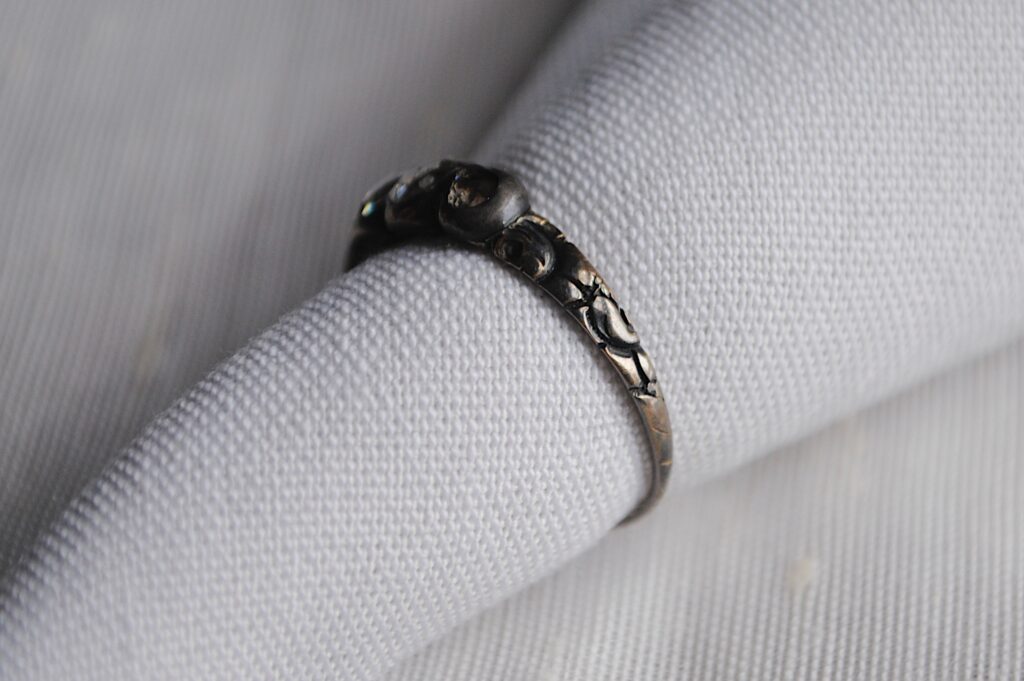
Detail of the ring’s band, done with repoussé and chasing techniques to add delicate motifs. Note the smaller replacement diamond.
With this knowledge, the original object file’s English attribution of the ring suddenly required further investigation. Colonists in early America were certainly importing jewelry and other fine goods from England and France – sometimes out of cost-based necessity, but often, as Boston was solidifying itself as a viable place of commerce and craft, seeking goods from abroad was a sign of culture and cosmopolitan identity.[5] Historian Kimberly S. Alexander writes in Treasures Afoot: Shoe Stories from the Georgian Era, that even Patriot women like Martha Washington and Abigail Adams purchased material goods from makers based in London and Paris.[6] Looking at trade between America and England is not as cut and dry as we often think it might’ve been – it was not always a black-and-white situation of economic dependence, or a cultural deficit that forced Americans to look across the pond for fashion. Rather, foreign-made goods were often sought after as signifiers of taste and value. This trend included jewelry. Local jewelers, popping up in cities like Boston and Philadelphia, began to grow in popularity, but many of these shops both made their own goods and imported from Europe. Over time, mass-produced jewelry, silver and gold plating, and paste diamond technology allowed for jewelry to be made in America at lower costs for both the makers and consumers.[7] Yet given the simple but fine craftsmanship, techniques that could have feasibly been used by local craftspeople, and modest diamonds, it is not improbable to suggest that the ring was made by a silversmith in Paul Revere’s Boston.
There is, undoubtedly, still much to learn about Rachel Revere’s ring. Who made it? Is it true that, as we assume, Paul Revere gave the ring to Rachel, and if so, what was the occasion? The beauty of collections research is very much like assembling a puzzle: when we move with patience, ask for assistance from others, zoom out to see the bigger picture, and then return after stepping away, we can often begin to see the full picture in unexpected and clarifying ways.
Many thanks to Tracey Jenkins Darji and the folks at the Jewelry Making & Repair Department at the North Bennet Street School for their assistance in identifying materials in Rachel Revere’s ring and pointing us in new directions to look for further answers.
Isabelle Ackerman is an Interpreter at the Paul Revere House.
[1] Britannica Editors, “Paste | Manufacturing, Uses & History | Britannica,” Britannica, 1998, https://www.britannica.com/technology/paste-glass-product.
[2] Darji’s diamond tester was a small, pen-shaped device that was able to scan and read the thermal conductivity of the stones in the ring. In order to authenticate the stones as diamonds, we were looking for a low temperature reading – diamonds both conduct and disperse heat well, in contrast to glass, which retains heat.
[3] Fales, Martha Gandy. Jewelry in America, 1600–1900. Woodbridge, Suffolk, U.K.: Antique Collectors’ Club, 1995. (p.148)
[4] Hunter, Edward. “Fire Gilding of Arms and Armor.” The Metropolitan Museum of Art, July 1, 2007. https://www.metmuseum.org/essays/fire-gilding-of-arms-and-armor.
[5] Eisenbarth, Erin E. Baubles, bangles, and beads: American jewelry from Yale University, 1700-2005. New Haven: Yale University Art Gallery, 2005. (p. 7)
[6] Alexander, Kimberly S. Treasures Afoot: Shoe Stories from the Georgian Era. Baltimore: Johns Hopkins University Press, 2018. (p. 86, 167)
[7] Fales, Martha Gandy. Jewelry in America, 1600–1900. Woodbridge, Suffolk, U.K.: Antique Collectors’ Club, 1995. (p.149)